


Benefits of Professional Wall Bed Installation in 2026
Table of Contents
- Why Professional Wall Bed Installation Matters More Than the Bed Itself
- Murphy Bed Installation Safety Requirements: What's at Stake
- Average Time for Professional Wall Bed Installation: What to Expect
- How Professional Installation Protects Your Warranty and Investment
- How to Prepare Your Room for a Wall Bed Installation
- The Real Benefits of Professional Wall Bed Installation: Safety, Precision, and Long-Term Value
- Conclusion: Invest in Professional Expertise for Peace of Mind
- Frequently Asked Questions
Last Updated: September 8, 2026
The bed you choose for your home office or guest room matters, but the way it gets mounted to your wall matters more. A wall bed that isn't properly anchored is a safety hazard, regardless of how much you paid for the cabinetry. This guide from Comfort Zone Shop breaks down the benefits of wall bed professional installation, covering safety requirements, warranty protection, and why precision alignment determines whether your mechanism lasts for decades or fails within years.
Professional installation is the difference between a furniture piece and a permanent architectural feature. Below, we'll walk through what's at stake, what the installation process involves, and how to prepare your space so the job gets done right the first time.
Why Professional Wall Bed Installation Matters More Than the Bed Itself
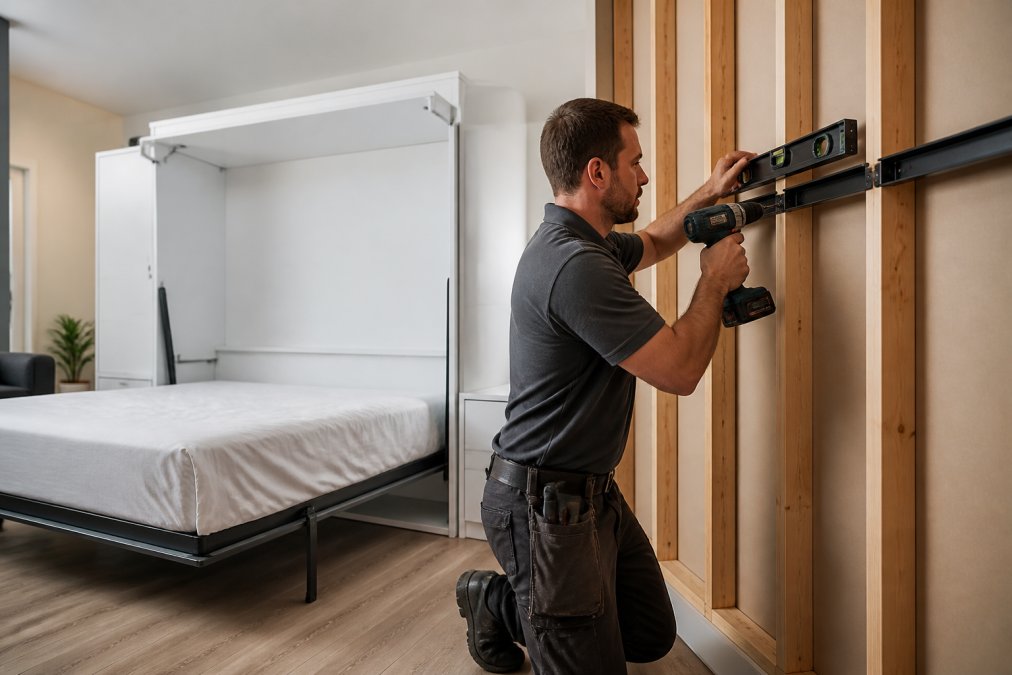
Wall bed professional installation matters because the mounting hardware carries a load that changes dynamically every time the bed is raised or lowered. A murphy bed doesn't just sit on the floor; it pivots on hinges and transfers hundreds of pounds of force into your wall studs daily.
Unlike a bookshelf or a dresser, a wall bed must maintain precise alignment through thousands of open-and-close cycles. Even a slight deviation in leveling creates friction, accelerating wear on moving parts and eventually causing the bed to bind or drop unevenly.
A level, securely anchored frame distributes weight evenly across load-bearing studs, while a poorly mounted frame concentrates stress on a single point. Professional installers account for this dynamic during every step of the mounting process.
Murphy Bed Installation Safety Requirements: What's at Stake
Murphy bed installation safety requirements exist because a falling wall bed can cause serious injury. These beds feature heavy counterbalance systems and solid wood frames that can weigh several hundred pounds. If the unit detaches from the wall during use, the consequences range from damaged flooring to trapped occupants.
Safety standards emphasize proper anchoring as the single most critical installation factor. A wall bed must be secured to structural framing, not just drywall or plaster. This is why manufacturers typically void warranties when installation is done improperly.
Wall Support and Stud Location
The wall that supports your murphy bed must contain solid framing at the exact mounting points. Professional installers use stud finders to locate the structural members behind your drywall, then verify they're positioned to match the bed's mounting brackets.
Not every wall is suitable for a wall bed. Walls with plumbing runs, electrical conduit, or HVAC ducts can interfere with stud placement. An experienced installer assesses these conditions before drilling.
Wall Type Challenges: Drywall, Concrete, Brick, and Metal Studs
The material behind your wall finish dictates the mounting hardware and technique required. A professional installer matches the anchoring strategy to the substrate.
Drywall over wood studs is the most common scenario in residential construction. The installer must hit the center of the stud, not just the edge, as a bracket screwed into the edge has significantly less holding power. Professionals use a stud finder with deep-scan capability to locate the center.
Concrete or masonry walls have no studs, so the installer must use sleeve or wedge anchors rated for the sheer and pull-out forces of a wall bed. Drilling requires a hammer drill with a carbide-tipped bit, and the hole depth and diameter must match the anchor specifications exactly. A hole that is too shallow or too wide will not allow the anchor to expand properly, leading to a loose mount that fails over time.
Brick or block walls are similar to concrete but have mortar joints weaker than the brick itself. A professional installer will avoid anchoring into mortar joints whenever possible, as the mortar can crumble under stress, and will drill into the face of the brick or block instead.
Metal studs are common in commercial buildings and some newer condominiums. They are thinner than wood and can deform under the concentrated load of a wall bed's mounting bracket. A professional installer will use toggle bolts or specialized metal-stud anchors that distribute the load over a wider area, or may install a plywood backing plate between the studs to provide a solid mounting surface.
Each of these wall types requires a different tool, anchor, and approach. A DIY installer who buys a generic anchor kit is gambling that their wall matches the kit's assumptions, while a professional brings a full inventory of fasteners and the knowledge to select the right one.
Mechanism Safety and Counterbalance Systems
Wall bed mechanisms rely on spring-based or piston-based counterbalance systems calibrated at the factory, but the calibration only works correctly when the frame is perfectly level and square.
A professional installer verifies the mechanism's operation through multiple test cycles after mounting, checking that the bed rises smoothly, locks securely in the upright position, and descends without binding. This testing phase catches alignment issues that would otherwise surface weeks later as a stuck or erratic mechanism.
Watch Out
If your wall is not standard drywall over wood studs, do not assume a standard installation kit will work. Ask your installer specifically what anchoring method they will use for your wall type. If they cannot give you a clear answer, that is a red flag.
Average Time for Professional Wall Bed Installation: What to Expect
The average time for professional wall bed installation typically falls between two and four hours for a standard unit, assuming a clear work area, accessible wall studs, and no unexpected structural complications.
The process breaks down into distinct phases. Unpacking and staging the unit takes roughly 30 minutes. Positioning the cabinet and marking mounting points requires another 30 to 45 minutes of careful measurement. Drilling, anchoring, and securing the frame typically consumes an hour. The final phase, which includes leveling, mechanism testing, and trim adjustment, takes the remaining time.
| Installation Phase | Typical Duration | Key Activities |
|---|---|---|
| Unpacking and staging | 30 minutes | Inspect parts, clear packaging, organize hardware |
| Measuring and marking | 30-45 minutes | Locate studs, verify level, mark mounting points |
| Mounting and anchoring | 60 minutes | Drill pilot holes, secure brackets, attach frame |
| Leveling and testing | 30-45 minutes | Adjust alignment, test mechanism cycles, finish trim |
Complex installations take longer. Custom cabinetry, crown molding integration, or walls with unusual construction can extend the timeline to a full day.

How Professional Installation Protects Your Warranty and Investment
Wall bed warranties hinge on proper installation. Most manufacturers require professional installation to keep the warranty valid, and for good reason: the mechanism is precision-engineered, and incorrect mounting damages components in ways that are difficult to detect until failure occurs.
A wall bed represents a significant investment in your home. Quality units feature solid wood construction, custom cabinetry, and mechanisms rated for tens of thousands of cycles. Protecting that investment means ensuring every component operates within its design parameters from day one.
Professional installation also protects you from liability. If a DIY installation fails and causes property damage or personal injury, your homeowner's insurance may not cover the claim, as many policies exclude damage from improper installation. Documentation of professional installation provides clear evidence the unit was mounted according to manufacturer specifications.
Watch Out
Skipping professional installation to save money often voids your warranty entirely. If a mechanism fails and the manufacturer determines improper mounting caused the issue, you'll cover the full replacement cost out of pocket.
The Post-Installation Maintenance Checklist: Protecting Your Mechanism for Decades
Professional installation is the first step, but the long-term value of your wall bed depends on a simple maintenance routine. A few minutes of preventive care each year will keep the mechanism operating smoothly for decades.
Monthly Visual Inspection (2 minutes):
- Raise the bed to the upright position and lock it.
- Check the mounting brackets where they meet the wall for any visible gap or movement.
- Look at the hinge pins and pivot points for signs of wear, rust, or debris buildup.
- Verify that the cabinet doors and trim show no new gaps or misalignment, which can indicate frame shift.
Quarterly Mechanism Check (5 minutes):
- Lower the bed halfway and let it rest. It should hold its position without drifting down or springing up.
- Raise and lower the bed three full cycles, listening for any grinding, clicking, or squeaking sounds.
- Inspect the gas pistons (if your model uses them) for oil leaks or signs of pressure loss. A piston that does not provide smooth resistance is failing.
- Check the tension springs (if your model uses them) for any signs of stretching or deformation.
Annual Lubrication (10 minutes):
- Use a dry PTFE spray lubricant on the pivot points and hinge mechanisms. Do not use oil-based lubricants, which attract dust and gum up over time.
- Apply a small amount of lubricant to the locking mechanism that holds the bed in the upright position.
- Wipe away any excess lubricant with a clean cloth.
Every 5 Years: Professional Re-Torque Check:
- The screws and bolts that anchor your bed to the wall can loosen slightly over years of vibration from opening and closing. A professional can re-torque all mounting hardware to the manufacturer's specified foot-pounds, ensuring the bed remains as secure as the day it was installed.
- This is also a good time to have the counterbalance system re-calibrated if you notice the bed becoming heavier to lift or faster to drop.
This checklist is not just about performance; it is about warranty compliance. Most manufacturer warranties require the unit be maintained according to the owner's manual, and documenting your routine gives you a clear record if you ever need to file a claim.
A professionally installed wall bed that receives this simple maintenance routine will outlast a neglected unit by years. The checklist bridges the gap between the initial installation and the decades of reliable service you expect from your investment.
How to Prepare Your Room for a Wall Bed Installation
Clear the Work Area
Remove furniture, rugs, and wall decor from the installation zone. The installers need unobstructed access to the wall and enough floor space to maneuver the bed unit. Clearing the area also protects your possessions from dust and accidental contact during the mounting process.
Cover flooring with protective sheets, especially if you have hardwood or carpet that could be scratched by tools or hardware. Confirm that the path from your entryway to the installation site is clear, since the bed ships in large, heavy packaging.
Confirm Wall Construction
Before scheduling installation, confirm what's behind your drywall. Interior walls in most modern homes use wood studs spaced 16 inches apart, but older homes may have metal studs, plaster over lath, or other construction types that require different mounting hardware.
If you're unsure about your wall construction, ask your installer to perform a site assessment first. This visit takes minutes and prevents wasted effort on installation day. It also reveals any electrical wiring or plumbing that could complicate the mounting process.
The Real Benefits of Professional Wall Bed Installation: Safety, Precision, and Long-Term Value
The benefits of wall bed professional installation come down to three factors: safety, precision, and long-term value.
Safety is the non-negotiable foundation. A properly anchored wall bed supports its full weight through the counterbalance system and transfers forces safely into your home's structure.
Precision determines how the bed performs over time. Wall bed mechanisms demand exact alignment to operate smoothly, and professional installation ensures the frame is level, square, and properly adjusted, preventing premature wear on hinges, pistons, and pivot points.
Long-term value encompasses both warranty protection and resale appeal. A professionally installed wall bed with documented installation protects your manufacturer warranty and functions reliably for decades, making it a worthwhile investment for any multi-purpose room transformation.
Key Takeaway
Professional installation transforms a wall bed from a potential liability into a dependable, space-saving feature. The cost of professional labor is small compared to the cost of repairing damage from a failed DIY installation or replacing a bed whose warranty was voided by improper mounting.
Conclusion: Invest in Professional Expertise for Peace of Mind
Wall bed professional installation is not an optional upgrade; it's the factor that determines whether your space-saving investment performs safely and reliably. From structural integrity and mechanism safety to warranty protection and insurance liability, the case for professional expertise is clear.
At Comfort Zone Shop, we handle the delivery and installation of our wallbeds and custom cabinetry so you never have to worry about stud location, alignment, or counterbalance calibration. Our team serves the Tampa Bay area with professional service that protects your investment and your peace of mind. We also offer instant rebates on wallbeds and custom mattress manufacturing to ensure your new bed fits your space and your comfort preferences perfectly.
Get started with Comfort Zone Shop and turn your spare room into a safe, functional, multi-purpose space you'll enjoy for years.
Frequently Asked Questions
Why is professional installation recommended for wall beds?
Professional installation is recommended because a wall bed is a heavy, precision-engineered piece of furniture. Installers ensure the frame is anchored securely to wall studs, the mechanism is perfectly aligned, and the counterbalance system operates smoothly. Incorrect installation risks the bed falling, damaging your wall or floor, or causing injury. Professional expertise also keeps your manufacturer warranty valid, protecting your investment over the long term.
Does a wall bed require special wall reinforcement?
Most wall beds do not require adding extra reinforcement if they are mounted directly onto structural wall studs. A professional installer will locate studs and use heavy-duty lag bolts or similar hardware to secure the bed frame. For homes with metal studs, brick, or concrete block walls, special anchoring methods are necessary. An experienced installer assesses your specific wall type and uses the correct hardware to ensure the bed is securely and safely mounted.
How does professional installation affect the warranty of my wall bed?
Professional installation is often a condition to keep the manufacturer's warranty valid. Many warranties are voided if the bed is installed incorrectly or by an unqualified person. A professional installation provides documented proof that the bed was set up according to specifications. This protects you if a mechanism or component fails later. Attempting a DIY installation risks costly damage and leaves you without warranty coverage if something goes wrong.
What are the safety risks of an improperly installed Murphy bed?
An improperly installed Murphy bed poses serious risks. The most immediate danger is the bed pulling away from the wall and falling, which can cause significant injury or property damage. A misaligned mechanism can also bind, causing undue stress on the hardware and leading to premature failure. Our professional installation ensures the bed is anchored to structural supports and the mechanism is balanced correctly, eliminating these hazards.
Related post


27
Sep



23
Sep

