

How to Soundproof a Home Office for Guests
Table of Contents
- Start With the Shared Wall: Best Soundproofing Materials for Walls
- Stop the Leak: Soundproofing Door Gaps and Windows
- Floor and Ceiling Fixes for Impact Noise
- Using Murphy Beds for Space-Saving Guest Rooms
- Budget-Tiered Soundproofing: From Cheap Fixes to Full Renovation
- Aesthetics vs. Performance: Making Soundproofing Look Good
- Conclusion
- Frequently Asked Questions
Last Updated: September 10, 2026
Start With the Shared Wall: Best Soundproofing Materials for Walls
The wall your home office shares with a guest room is almost always the weakest point in the room, and it is where you should spend your first dollar. Learning how to soundproof a home office for guests starts with understanding one distinction most guides skip: blocking sound and absorbing sound are two different jobs, and they need two different materials. This guide from Comfort Zone Shop walks through how to soundproof a home office for guests, from the shared wall to the last door gap.
Soundproofing is the practice of reducing how much noise passes from one side of a structure to the other, using mass, sealing, and decoupling. Sound absorption is different: it reduces how much sound bounces around inside a room, which controls echo but does little to stop noise traveling through a wall.
That difference drives every buying decision you will make.
Mass-loaded vinyl is a thin, dense barrier that adds weight to a wall without adding much thickness, which matters in a condo where you cannot build out six inches. Mineral wool insulation inside the stud cavity absorbs sound energy before it crosses to the other side. Resilient channels decouple drywall from the framing, breaking the physical path vibration travels along. Each layer handles a different part of the problem, and stacking them is what produces real decibel reduction.
Watch OutSkipping the sealing step and buying expensive panels instead is the most common mistake. A single unsealed electrical outlet or a gap along the baseboard can undo most of the mass you just added.
Mass-Loaded Vinyl and Drywall Techniques
Adding a second layer of drywall with a damping compound between the sheets, often called double drywall, is the highest-impact wall upgrade available without opening the wall. Mass-loaded vinyl goes on next, then a final drywall layer if space allows. The goal is simple: more mass, fewer gaps, and no rigid connection between the two sides of the wall.
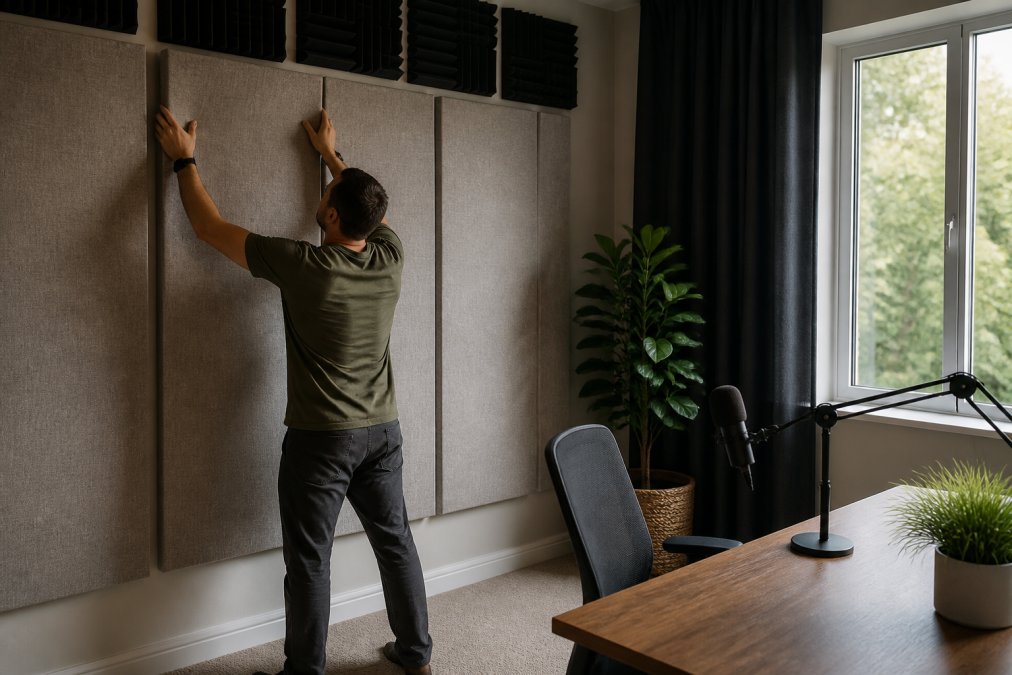
Acoustic Panels and Sound Absorption vs. Blocking
Acoustic panels and acoustic foam are absorption tools, not blocking tools. They reduce reverberation inside the office so calls sound cleaner, but a panel on the office side of a shared wall will not meaningfully quiet the guest room. Use panels to fix echo, and use mass and sealing to fix transmission.
Goal |
Material |
What It Fixes |
|---|---|---|
Stop noise crossing a wall |
Mass-loaded vinyl, mineral wool, double drywall |
Airborne noise through the shared wall |
Reduce echo in the room |
Acoustic panels, acoustic foam, soundproofing blankets |
Reverberation and call clarity |
Stop drafts and noise at doors |
Door sweep, draft stopper, weather stripping |
Sound leakage around the door frame |
Reduce footstep noise |
Floor underlayment, rug pads |
Impact noise through the floor |
Stop the Leak: Soundproofing Door Gaps and Windows
Soundproofing door gaps is the cheapest, fastest win in the entire project, and it is the step most people do last. A standard interior door leaves a gap at the bottom and often a thin seam around the frame. Air carries sound, so every gap is a direct path between rooms.
Start with a door sweep or draft stopper for the bottom edge, then acoustic caulk or soundproofing sealant around the frame. Weather stripping handles the sides and top. If the door itself is hollow-core, it will still transmit noise; a solid-core door or a soundproofing blanket hung on the office side helps, but the seal matters more than the door.
Windows are the other leak. Soundproofing curtains layered over an existing window reduce airborne noise noticeably. For a stronger fix, acoustic caulk the frame seams and add a second pane or a window insert if the budget allows.
Pro TipTest your seal with a dollar bill. Close the door on it and pull. If it slides out with no resistance, sound is escaping through that same gap.
Floor and Ceiling Fixes for Impact Noise
Impact noise is the thud of footsteps, a chair rolling, a dropped phone, or a suitcase landing on the floor. It travels through the structure itself, joists, subfloor, framing, so a panel on the wall will not touch it. This is the noise that wakes a guest at 6 a.m. when you start your first call, and it is the one most guides underweight because it is invisible in a materials list.
The mechanism matters here. Airborne noise (voices, TV, music) moves through air and is stopped by mass and sealing. Impact noise moves through solid material as vibration, and it is stopped by decoupling and damping, breaking the rigid path between the source and the structure. That is why the fix is different, and why buying more wall panels will not solve a footstep problem.
Floor-side fixes (best when you control the office floor):
- Acoustic underlayment under hardwood, laminate, or LVP. Look for products rated for impact isolation; cork, recycled rubber, and felt-composite underlayments are the common categories. Thickness and density drive performance, and a denser 3-6 mm rubber underlayment typically outperforms a thin foam pad.
- Dense rug pads under area rugs. A rug alone does almost nothing for impact noise; the pad is what absorbs the vibration. A felt-and-rubber pad in the 1/4-inch to 1/2-inch range is the practical sweet spot.
- Chair glides or a rolling-chair mat under the desk chair. This is the single cheapest impact fix in a home office and the one guests notice most, because a hard-wheeled chair on hardwood is a continuous drumbeat.
Ceiling-side fixes (best when the guest room is below the office):
- Resilient channels on the ceiling below, with a second layer of drywall, decouple the ceiling from the joists and interrupt the vibration path. This is renovation-level work and usually requires opening the ceiling.
- Mineral wool in the ceiling cavity adds absorption and some mass, but on its own it will not stop impact noise, it works as part of a decoupled assembly, not as a standalone fix.
- A suspended acoustic ceiling or a dropped ceiling with isolation clips is an option in a basement guest room where you have headroom to spare.
Pro TipIf the guest room is directly below the office, prioritize the floor-side fixes first. They are cheaper, reversible, and address the exact path the noise is using. Save the ceiling work for a renovation you are already doing.
The guest-room trade-off. Every impact fix that adds thickness to the floor raises the floor level and can create a trip hazard at the doorway, and every ceiling fix that drops the ceiling makes the guest room feel lower and more enclosed. In a dual-purpose room, the guest's comfort is part of the brief. A dense rug pad plus chair glides solves most real-world complaints without changing the room's proportions at all, which is why it belongs in Tier 1, not Tier 3.
If you are converting a second-floor room, prioritize underlayment under any hard flooring before you buy a single wall panel. It is the difference between a guest who sleeps through the night and one who does not.
Using Murphy Beds for Space-Saving Guest Rooms
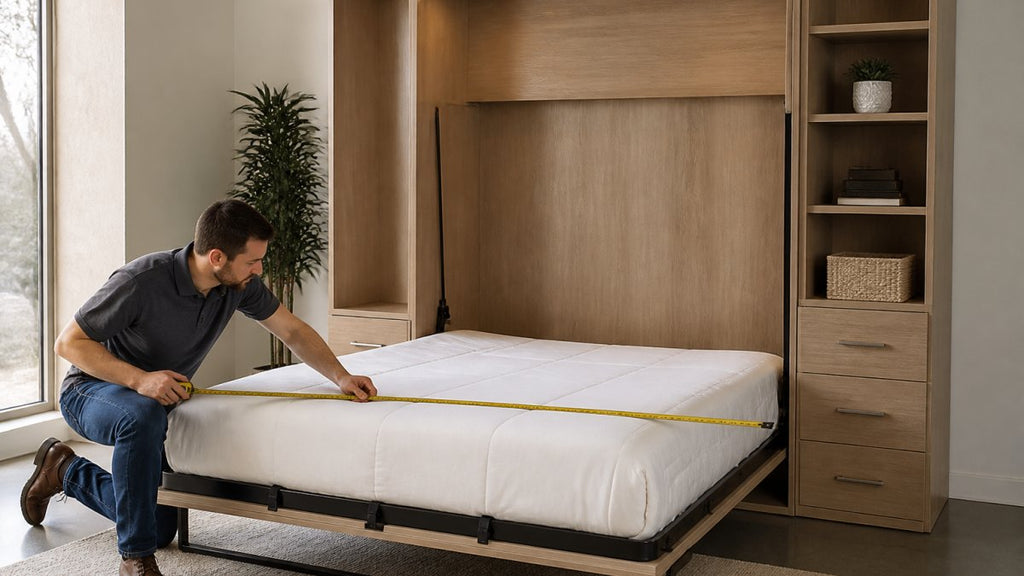
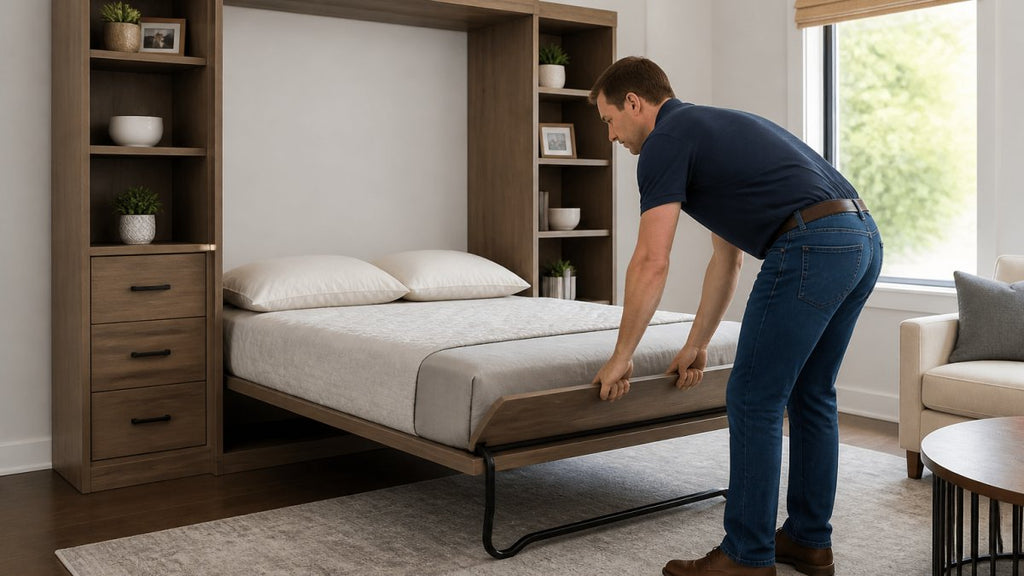
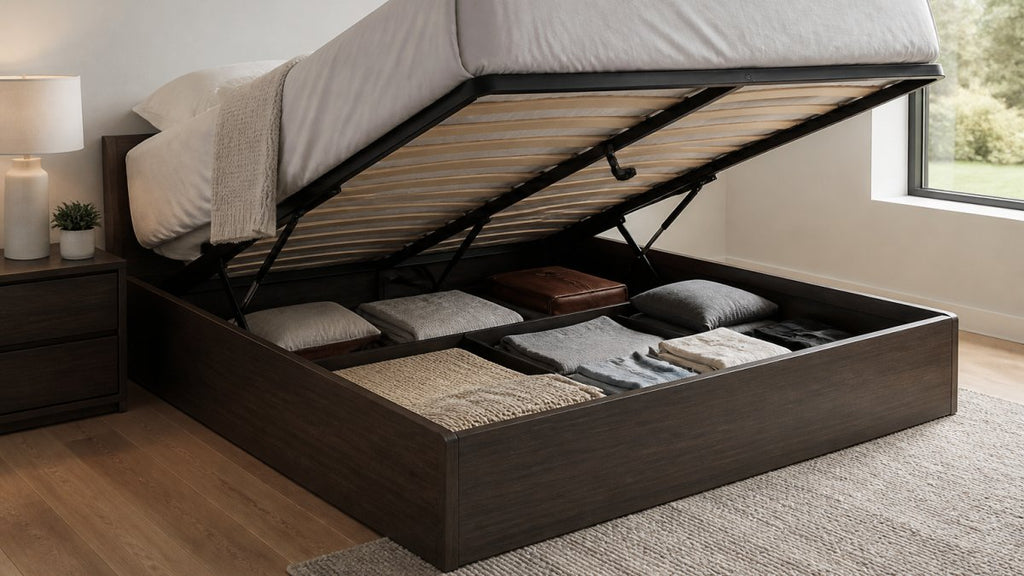
A dual-purpose room only works if the furniture supports both jobs. Using Murphy beds for space-saving guest rooms solves the core conflict: the guest needs a real bed, and the office needs floor space during working hours. A wall bed folds away against the wall by day and drops into a full sleeping surface at night, which is precisely what a home office and guest room combination requires.

Comfort Zone Shop builds Murphy bed cabinets, wall beds, and storage beds specifically for rooms that have to do two things at once, serving homeowners across Tampa, Clearwater, St. Petersburg, Ocal and New Port Richey. Because the shop also manufactures custom-size mattresses, a wall bed can be fitted to unusual room dimensions rather than the other way around. Professional delivery and installation are available, which matters when a wall bed has to be anchored correctly to stay safe and stable over years of use.
One practical note: a wall bed changes the acoustics of a room. An open cavity behind a folded bed can act as a small resonance box, so if echo is a problem, treat that wall with an absorption panel after installation.
Budget-Tiered Soundproofing: From Cheap Fixes to Full Renovation
Soundproofing scales with budget, and you do not need to do everything at once. The two questions that decide your tier are: Do I own this space, or am I renting? and Is the noise coming through air, or through the structure? Answer those first, then work in tiers and stop when the noise problem is solved.
The most common mistake is buying materials out of order. Mass-loaded vinyl and acoustic panels are the fun purchases; door sweeps and acoustic caulk are the boring ones. But sealing is what makes mass work, and absorption only fixes echo, not transmission. Do the boring steps first, or the expensive steps will underperform.
Rental-Friendly / Non-Permanent Tier
These fixes are reversible, leave no damage, and travel with you when you move. They are also where most guests' complaints actually get solved.
- Door sweep or draft stopper for the bottom gap, the single highest-return fix in the room.
- Weather stripping around the door frame, sides and top.
- Acoustic caulk (removable, non-hardening) around outlets, baseboards, and window frame seams.
- Soundproofing curtains layered over existing window treatments.
- Dense rug pad plus chair glides to kill impact noise from the desk chair.
- Fabric-wrapped acoustic panels for echo control, these double as wall decor, which matters in a guest room.
- A solid-core door swap, if the landlord allows it and you store the original.
Owner / Semi-Permanent Tier
These require minor work but are still reversible with effort.
- Second layer of drywall with a damping compound between the sheets (double drywall).
- Mass-loaded vinyl applied to the shared wall before finishing.
- Acoustic underlayment under hard flooring.
- A wall bed cabinet that adds mass and finished surface to a wall while freeing floor space, a rare case where a furniture purchase also improves acoustics.
Renovation-Heavy / Permanent Tier
These require opening walls or ceilings and are best done during a remodel you are already planning.
- Mineral wool insulation in the stud or joist cavity.
- Resilient channels to decouple drywall from framing.
- Ceiling decoupling below the office if the guest room sits underneath.
- A second window pane or window insert for street noise.
Watch OutDo not start with Tier 3. A homeowner who installs mass-loaded vinyl and resilient channels but leaves a half-inch gap under the door has spent thousands and still hears every word from the guest room. Seal first, absorb second, add mass third.
How to Know When to Stop
Work the tiers in order and re-test after each one. A practical test: stand in the guest room, close the door, and have someone talk at normal volume in the office. If you can hear the words but not understand them, you are close, one more sealing pass usually finishes the job. If you can understand full sentences, you still have an air leak, and more mass will not fix it.
Most homeowners find the rental-friendly tier handles the majority of complaints. The owner tier is for shared walls in condos or apartments where structural sound isolation is genuinely poor. The renovation tier is for people already opening walls for another reason, never open a wall just for soundproofing unless the noise problem is severe.
Key TakeawaySeal first, absorb second, add mass third. Match the tier to whether you rent or own, and re-test after every tier instead of buying the whole list at once.
Aesthetics vs. Performance: Making Soundproofing Look Good
Performance and looks are not opposites, but they do require planning. The most effective treatments, mass-loaded vinyl and double drywall, sit behind the finished wall and are completely invisible. That is the good news: your highest-impact work is also your least visible.
The visible pieces are the ones to design around. Acoustic panels now come in fabric-wrapped finishes that read as wall art. Soundproofing curtains can be chosen in colors that match the room. A wall bed cabinet itself hides a significant amount of wall surface and adds a finished, built-in look rather than a bare mattress on a frame.
Where aesthetics usually lose is at the door. A heavy sweep and thick weather stripping are not pretty, but they are small and repaintable. Do not skip them for looks.
Conclusion
The hardest part of a dual-purpose room is that it has to be quiet for calls and quiet for sleep, and those two goals pull in different directions. Start with the shared wall and the door seal, add absorption only where echo is the real problem, and choose furniture that lets the room change function without a renovation.
Comfort Zone Shop builds Murphy bed cabinets, wall beds, and storage beds designed for exactly this kind of room, with custom-size mattress manufacturing, professional delivery and installation, and instant rebate offers. Get started with Comfort Zone Shop and turn your home office into a guest room that actually works.
Frequently Asked Questions
How do I make my home office more soundproof?
Start by sealing gaps around doors and windows with weather stripping and acoustic caulk. Add mass-loaded vinyl or a second layer of drywall to shared walls. Use acoustic panels to reduce echo, and place a thick rug or floor underlayment to dampen impact noise. For a dual-purpose guest room, a Murphy bed frees up floor space for these treatments.
What is the difference between soundproofing and sound absorption?
Soundproofing blocks noise from entering or leaving a room by adding mass and sealing air gaps. Sound absorption reduces echo and reverberation inside the room using soft materials like acoustic foam or panels. For a home office, you need both: blocking to keep conversations private and absorption to make video calls sound clear.
Does furniture placement help soundproof a room?
Yes. Placing a tall bookcase or a Murphy bed cabinet against a shared wall adds mass and can reduce sound transmission. Soft furnishings like curtains and rugs absorb sound. However, furniture alone won't stop noise; combine it with door seals and wall treatments for noticeable decibel reduction.
What are the best soundproofing materials for a guest room office?
For walls, mass-loaded vinyl, mineral wool, and double drywall with resilient channels work well. For doors, use a door sweep and acoustic caulk. Acoustic panels and soundproofing curtains handle echo. If the room doubles as a guest room, choose a Murphy bed with a custom mattress from Comfort Zone Shop to save space without sacrificing comfort.
Related post

08
Oct
30
Sep

