

How to Organize a Small Tampa Condo Kitchen for More Space
Last Updated: November 7, 2026
Quick Summary
To organize a small Tampa condo kitchen, purge first using the three-box Keep, Donate, and Toss method, keeping only items you used in the past year. Then zone your cabinets by task, measure every cabinet and drawer before buying organizers, and choose renter-safe installations that leave no wall damage.
- Empty one cabinet at a time and keep only what you used in the past year.
- Pick one galley run as the cooking wall and keep the walkway completely clear.
- Group items into coffee, cooking, prep, and cleaning zones so you stop walking in circles.
- Subtract a half inch from each cabinet measurement so organizers fit inside.
- Store flour, sugar, and cereal in airtight containers to keep pests out.
Ready to free up space in your condo?Comfort Zone Shop builds custom cabinetry and wall beds that fit small condo rooms.
Plan Your Storage Upgrade
Table of Contents
- Start With a Clean Slate: Purge and Categorize
- Small Kitchen Organization Ideas That Fit Condo Layouts
- Small Kitchen Storage Ideas on a Budget
- How to Organize a Small Kitchen With No Pantry
- Measure Before You Buy: Fit Checks for Narrow Cabinets and Drawers
- Renter- and Condo-Safe Installation Guide
- Keep Counters Clear and Store Cookware, Bakeware, and Appliances
- Plan Your Next Storage Upgrade With Comfort Zone Shop
- Frequently Asked Questions
Start With a Clean Slate: Purge and Categorize
Learning how to organize a small Tampa condo kitchen starts with subtraction, not storage runs. Most people buy bins before they know what they own, and that is why the clutter comes back. Small condo kitchens often run into the same pattern: too much stuff, too few decisions.
Here is the fix. Empty one cabinet at a time and sort everything into three piles. Keep only what you used in the past year.
The Three-Box Method for Kitchen Decluttering
Grab three boxes and label them Keep, Donate, and Toss.
- Keep: items you reached for in the last 12 months
- Donate: duplicate tools, unused gadgets, extra mugs
- Toss: cracked lids, bent utensils, expired food
A common mistake is keeping the "just in case" items. In a condo kitchen, just-in-case items are the enemy. Every item you keep takes space from something you actually use.
Once the boxes are full, wipe down the empty shelves. You now have a blank canvas.
Small Kitchen Organization Ideas That Fit Condo Layouts
Condo kitchens rarely follow one shape. Some are galley layouts, some are L-shaped, and many open straight into the living room. Organize around your layout, not against it. The goal in every case is the same: protect the walkway, protect the counter, and keep daily items within one arm's reach of where you use them.
Before you buy a single bin, walk your kitchen and note three measurements: the clear width of the main walkway, the clear depth of counter space beside the sink and stove, and the distance from the most-used cabinet to the cooking zone. A walkway that is narrow when two people cook can feel cramped, and shallow counter runs push you toward stacking rather than spreading out. Write your numbers down; every layout decision below depends on them.
Galley Kitchens
A galley kitchen is two parallel runs with a walkway between them. The mistake is treating both runs equally. Pick one run as the cooking wall (stove, oils, pots, spatulas) and the other as the prep and storage wall (cutting boards, mixing bowls, dry goods). Keep the walkway completely clear, no rolling carts parked in the middle, no trash can jutting into the path.
L-Shaped Kitchens
The corner is the hardest-working and most wasted spot in an L-shape. A lazy Susan or a corner carousel lets you reach the back of a blind corner cabinet; without one, that space becomes a graveyard for mismatched lids. Put your heaviest, least-used items (stand mixer, stockpot, bulk appliances) in the corner and your daily items on the two arms closest to the sink and stove.
Open-Plan Kitchens
When the kitchen shares a wall or sightline with the living room, visual clutter reads as room clutter. Closed storage wins here: put mismatched packaging, small appliances, and bulk goods behind cabinet doors, and reserve open shelving for matching, attractive items only. An island or peninsula often doubles as a divider, so keep the side facing the living area free of drying racks and dish piles.
One-Wall and Builder-Basic Layouts
Many condos have a single wall of cabinets with the fridge at one end and the sink at the other. Vertical space is your main option for expansion.
Zone Your Cabinets by Task, Not by Item Type
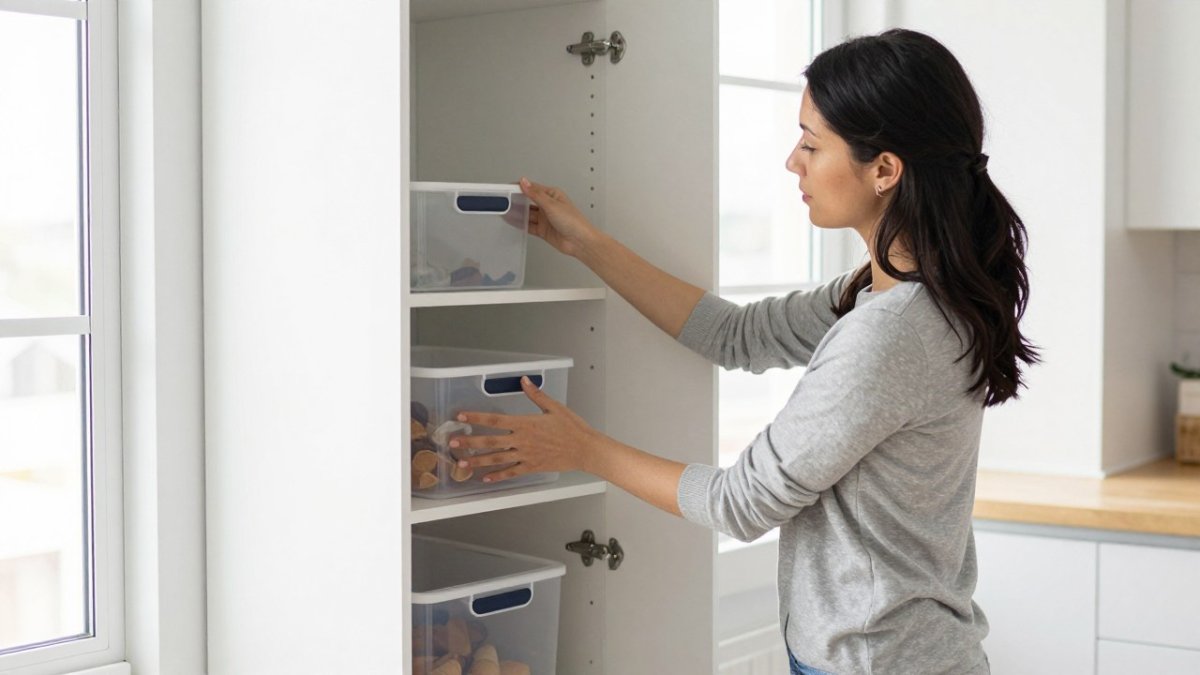
Group items by what you do, not what they are. This is the single biggest upgrade for a small kitchen.
- Coffee zone: mugs, filters, sugar, and the coffee maker together
- Cooking zone: pots, pans, spatulas, and oils near the stove
- Prep zone: knives, cutting boards, and mixing bowls near the counter
When everything for one task lives in one spot, you stop walking in circles. That matters when your kitchen is the size of a hallway. Some people place the coffee zone at the end of the run farthest from the stove so brewing and cooking do not compete for the same counter.
Small Kitchen Storage Ideas on a Budget
You do not need a big spend to gain real storage.
Start with what you already have. Reuse glass jars for bulk goods. Turn a mug tree into a lid holder.
Then add a few low-cost items:
- Shelf risers to double cabinet height
- Drawer dividers to stop utensil pileups
- Over-the-door racks for the cabinet doors
Watch out: measure the gap before you buy the cart. A cart that is a half-inch too wide becomes another item you have to store.
For more space-saving furniture that fits condo living, see our space-saving furniture for condos guide.
How to Organize a Small Kitchen With No Pantry
A pantry-less kitchen is not a lost cause. When you organize a small kitchen with no pantry, you spread the pantry across the room instead of forcing it into one closet.
Use these spots:
- Cabinet depth: add pull-out shelves so you can see the back
- Wall space: open shelving or a pegboard for jars and spices
- Door backs: shallow racks for spices and foil
Keep bulk goods in clear containers. You will spot what is running low before you buy a third bag of rice.
Humidity can be hard on dry goods. Store flour, sugar, and cereal in airtight containers, not open bags. A sealed jar helps keep pests out and food fresh longer.
Measure Before You Buy: Fit Checks for Narrow Cabinets and Drawers
Measurements decide whether an organizer works or wastes your money. Do this before any purchase.
Write down three numbers for every cabinet and drawer:
- Inside width
- Inside depth
- Inside height
Then subtract a half inch from each. Your organizer must fit inside that smaller number.
For drawers, check the full pull-out distance.
Narrow cabinets are the hardest. Slim shelving and tiered racks work best there.
If you want storage built to your exact dimensions, explore our custom home office and cabinetry options.

| Space | What to Measure | Common Mistake | Fix |
|---|---|---|---|
| Upper cabinet | Width, depth, height | Forgetting the hinge | Subtract hinge space |
| Drawer | Width, depth, pull distance | Buying too-tall dividers | Check closing clearance |
| Fridge gap | Width and height | Guessing the gap | Measure twice, buy once |
| Under sink | Pipe placement | Blocking the shutoff valve | Leave the valve clear |
Renter- and Condo-Safe Installation Guide
Renters and condo owners face one shared limit: you cannot drill wherever you like. Condo rules and lease terms often restrict wall damage. The practical approach is to start with solutions that leave no trace, then move to minimal-damage options only after you have checked your documents.
Read Your Lease and Condo Rules First
Before any purchase, find the sections of your lease and condo association rules that cover wall alterations, adhesives, and mounting. Look for language about nails, screws, anchors, and "damage to walls." If the rules are unclear, ask your landlord or property manager in writing and keep the reply. This one step prevents the most common expensive mistake: mounting a heavy rack, then paying to patch and repaint at move-out.
Damage-Free Options and What They Actually Hold
- Tension rods under the sink for spray bottles and cleaning caddies. They rely on pressure between two surfaces, so they work best between cabinet sides or a cabinet wall and a perpendicular wall. They fail on drywall alone because the pressure point crushes the paper surface.
- Adhesive hooks rated for the weight you need. Check the package rating and stay well under it, a hook rated for 5 pounds should hold no more than about 3 pounds of real load, because grease, humidity, and time weaken the bond. Clean the surface with rubbing alcohol, let it dry fully, press firmly, and wait the full cure time before hanging anything.
- Freestanding shelving that needs no wall anchor. A slim bookcase or utility shelf beside the fridge adds storage without a single hole. Anchor it to the wall only if your rules allow, because a tall freestanding unit can tip.
Minimal-Damage Options When You Must Drill
If your lease and condo rules allow small holes, use a stud finder and keep holes small. A single well-placed screw into a stud is generally more secure than anchors into drywall.
Watch out: adhesive hooks can fail on greasy or humid walls, such as walls near the stove. Clean, dry, and cure before you trust any adhesive with weight.
Removal Without Damage
At move-out, remove adhesive hooks by heating the adhesive with a hair dryer on low, then pulling the tab slowly parallel to the wall, not straight out. Tension rods come down in seconds. Freestanding units move with you. If you drilled, fill holes with spackle, sand smooth, and touch up paint to match. Keep the original paint color on file; condo walls are often painted in a builder-standard color that is hard to match later.
Keep Counters Clear and Store Cookware, Bakeware, and Appliances
Clear counters make a small kitchen feel twice as big. The goal is simple: only daily-use items stay out.
Move everything else into a home:
- Pots and pans: stack with dividers or hang on a rack
- Bakeware: stand sheets upright in a slim slot
- Small appliances: store the once-a-week ones, keep the daily one out
A good rule: if you use it daily, it earns counter space. If you use it weekly, it goes in a cabinet. If you use it monthly, it goes high or far.
This one habit keeps the workspace open for actual cooking.
Plan Your Next Storage Upgrade With Comfort Zone Shop
Some kitchens hit a wall with bins and hooks. When that happens, built-in storage does more than any organizer can.
At Comfort Zone Shop, we offer wall beds and custom cabinetry that can help turn one room into a guest room and home office.
If you are ready to plan, read our guide on how to choose Comfort Zone Shop home furnishings before you visit.
Your condo kitchen will only stay organized if the storage fits the room.
Frequently Asked Questions
How do you organize a small condo kitchen when cabinet space is limited?
Start by emptying every cabinet and grouping items by how often you use them. Keep daily dishes and utensils in the most reachable spots, and move seasonal or bulk items to higher shelves or a rolling cart. Add shelf risers and drawer dividers to double vertical space, and use the backs of cabinet doors for hooks or slim organizers. In a small Tampa condo kitchen, the goal is to give prime real estate to the items you touch every day.
What are the best small kitchen storage ideas on a budget?
Command hooks, tension rods, wire shelving, and clear plastic bins cost little and add usable space fast. Use a tension rod under the sink to hang spray bottles, stack plates on inexpensive shelf risers, and mount a magnetic strip for knives. A rolling cart can serve as a movable pantry in a condo kitchen with no built-in storage. Measure your cabinets first so budget organizers actually fit narrow shelves and deep drawers.
How do you organize a small kitchen with no pantry?
Create a pantry zone using a slim rolling cart, an over-the-door rack, or a cleared cabinet shelf near the stove. Decant dry goods into stackable clear containers so you can see what you have and spot pests early, which matters in Florida humidity. Keep bulk buys limited to what fits your cart or shelf, and store potatoes, onions, and garlic in a ventilated basket away from heat. A consistent pantry zone prevents food from spreading across counters.
Can I add storage to a small kitchen without remodeling?
Yes. Renter-friendly options include over-the-door organizers, under-sink shelving, stackable bins, and freestanding slim shelving that needs no drilling. If you want built-in storage, custom cabinetry and wallbeds from Comfort Zone Shop can turn a spare wall or room into multi-use space, and professional delivery and installation is available. Always measure your space and check condo association rules before installing anything permanent.