
Murphy Bed Durability and Safety: What Lasts
Table of Contents
- Is a Murphy Bed Actually Safe? The Honest Answer
- Murphy Bed Installation Requirements: Anchoring, Wall Studs, and Compliance
- Wall Bed Weight Capacity: Static Load, Dynamic Load, and What the Numbers Mean
- Hardware That Decides Whether Your Wall Bed Lasts
- Murphy Bed Maintenance Tips That Prevent Mechanical Failure
- DIY vs. Professional Installation: A Safety Comparison
- Conclusion
- Frequently Asked Questions
Last Updated: September 16, 2026
Is a Murphy Bed Actually Safe? The Honest Answer
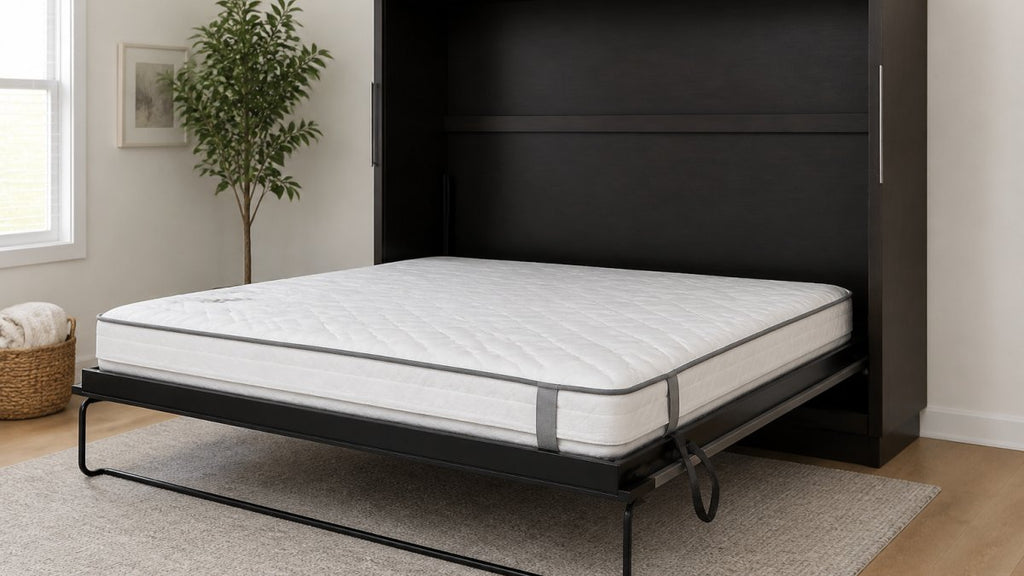
A well-built wall bed is safe when it is anchored into wall studs with hardware rated for the load, and murphy bed durability holds only as long as its lifting mechanism and hinges are maintained. That is the honest answer, and it is the one this guide from Comfort Zone Shop is built around.
The fear most people carry into a wall bed purchase comes from the cheap, poorly mounted units of decades past. Modern murphy bed durability and safety depends on three things: the anchoring system, the load capacity of the frame, and the condition of the counterbalance mechanism. Get those right and the bed will outlast most of the furniture in the room.
Below, we break down what actually determines whether a wall bed holds up over years of daily folding, and where cheap units fail.
Key TakeawaySafety is not a feature you buy once. It is a set of three mechanical systems, anchoring, load capacity, and counterbalance, that you inspect and maintain over the life of the bed.
Murphy Bed Installation Requirements: Anchoring, Wall Studs, and Compliance
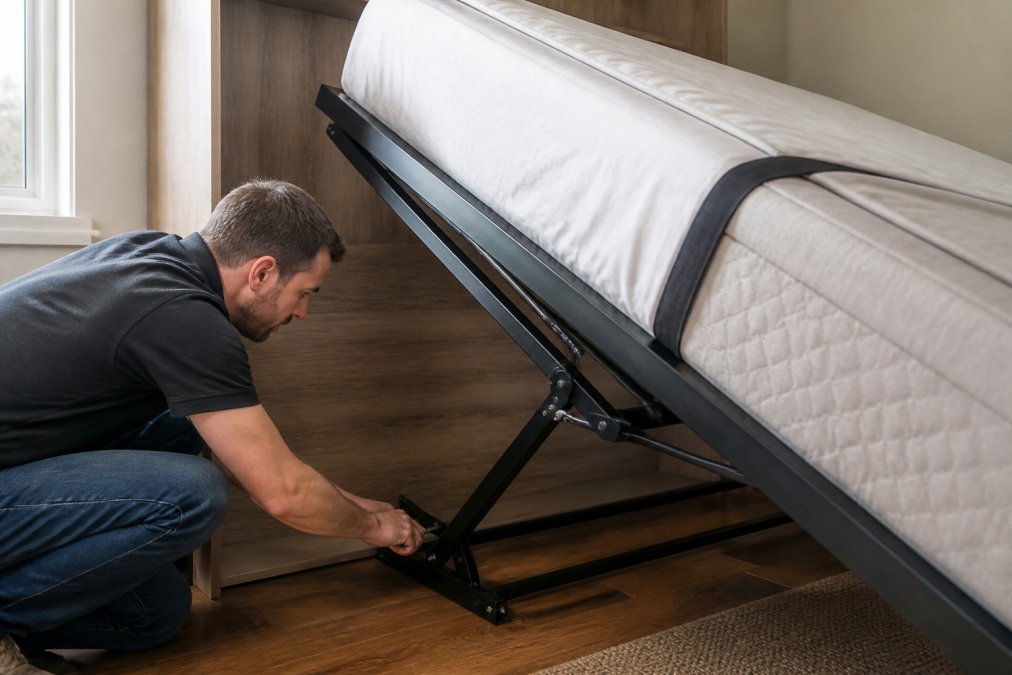
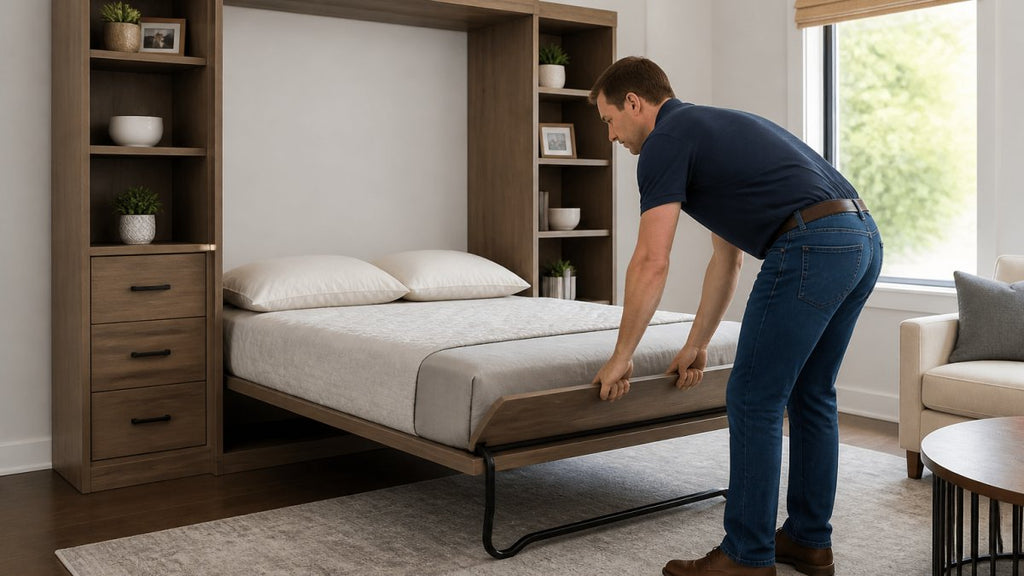
Murphy bed installation requirements come down to one non-negotiable rule: the cabinet must be fastened into wall studs, not drywall alone. A wall bed carries a dynamic load every time it opens and closes, and drywall anchors cannot absorb that repeated force. Installers locate the studs, mark them, and drive heavy-duty lag bolts or the manufacturer's specified mounting hardware through the cabinet's back rail into solid framing. Floor mounting at the base adds stability and prevents the cabinet from shifting.
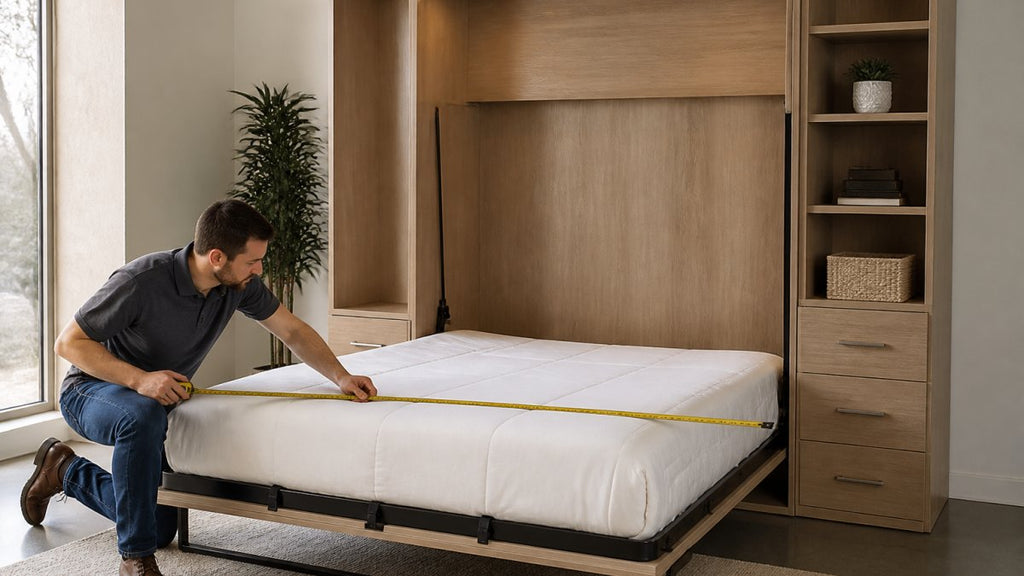
What most guides miss is that installation compliance is not just about the wall. It is also about the floor being level, the cabinet sitting plumb, and the mounting hardware matching the weight of the mattress you choose. A queen gel memory foam mattress weighs considerably more than a thin innerspring, and the anchor points feel that difference.
- Stud spacing must be confirmed before drilling. Standard framing is typically 16 inches on center, but older homes may have 24-inch spacing or irregular studs.
- Lag bolts should reach at least 2 inches into solid wood framing. Longer bolts are not always better; over-driving can split studs.
- The cabinet base should be shimmed level before final tightening. A plumb cabinet ensures the counterbalance mechanism operates within its designed range.
- All mounting hardware should be checked again after the first week of use, then monthly for the first three months as the bed settles.
U.S. Consumer Product Safety Commission guidance on furniture tip-over prevention outlines why anchoring furniture to structural framing matters, and the same principle applies to any folding bed.
Long-Term Structural Fatigue: What Happens After 5-10 Years
Most installation guides stop at the first week. But a wall bed that is opened and closed daily for five years accumulates over 1,800 cycles. Over ten years, that number exceeds 3,600. Each cycle introduces a small dynamic load at the anchor points, and over time, that repeated stress can cause microscopic movement in the framing or hardware.
This is where proper installation pays off. When lag bolts are driven into the center of studs and the cabinet is level, the load is distributed evenly across multiple anchor points. When a bolt misses a stud or is over-tightened, the load concentrates on fewer points, accelerating fatigue. A common pattern in older installations is that the bed begins to feel loose or squeaks at the pivot, which often indicates the anchor points are working loose.
To assess long-term fatigue, inspect the following every six months:
- Check for gaps between the cabinet back rail and the wall. Even a quarter-inch gap can indicate the cabinet is pulling away.
- Look for cracks in the drywall around the mounting points. Hairline cracks may signal movement.
- Test the counterbalance by opening and closing the bed slowly. If it feels harder to lift or drops suddenly, the mechanism may be compensating for a loose anchor.
If you notice any of these signs, re-tighten the mounting hardware and consult a professional if the issue persists. Comfort Zone Shop includes professional installation with every purchase, ensuring that anchoring and leveling are done to spec and that the bed is set up to handle years of daily use.
Wall Bed Weight Capacity: Static Load, Dynamic Load, and What the Numbers Mean
Wall bed weight capacity is measured two ways, and confusing them is why some beds feel solid for years while others loosen within months.
Static load is the weight the bed holds when it is open and someone is lying still on it. Dynamic load is the force generated when the bed is pulled down, pushed up, and sat on. Dynamic load is always higher, which is why a bed rated for a certain static weight still needs hardware built for repeated motion.
Daisy Murphy Cabinet Bed – A Stylish →
Weight distribution matters too. A mattress that is too thick or too heavy for the frame pushes the pivot point past its designed range, and the counterbalance mechanism has to work harder every single time.
Load Type |
What It Measures |
Why It Matters |
|---|---|---|
Static load |
Weight held while bed is open and still |
Sets the mattress and sleeper limit |
Dynamic load |
Force from opening, closing, and sitting |
Determines hardware and anchoring strength |
Distribution |
How weight spreads across the frame |
Affects pivot wear and hinge stress |
Hardware That Decides Whether Your Wall Bed Lasts
The hardware is where durability is won or lost. A solid wood frame means little if the piston-lift system or spring-loaded mechanism underneath it is undersized.
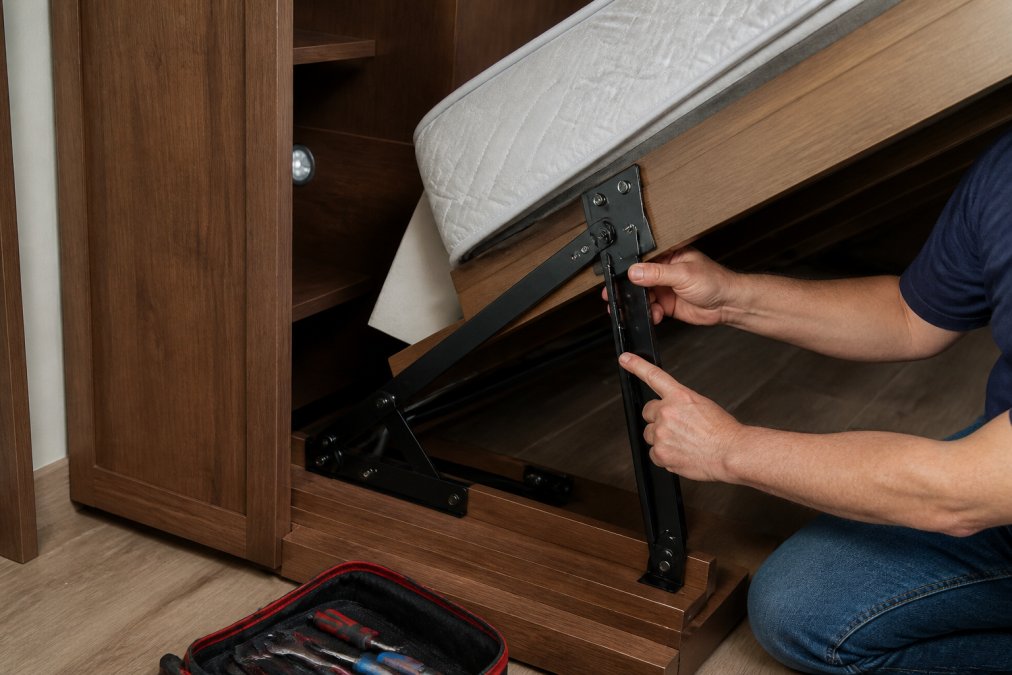
Counterbalance mechanisms fall into two broad families. Piston-lift systems use gas or hydraulic struts to assist the lift, while spring-loaded hardware uses tensioned springs. Both work well when they are matched to the mattress weight.
Watch OutMismatching the counterbalance tension to your mattress is the single most common cause of premature hardware failure. An over-tensioned spring makes the bed hard to pull down and stresses the hinge; an under-tensioned one lets the bed drop.
Long-Term Hardware Degradation: What to Expect Over 5-10 Years
Most articles focus on initial installation, but the real test of durability comes after years of daily use. Gas struts, for example, lose pressure over time. A strut that starts at 100 pounds of assist may drop to 70 pounds after five years, making the bed feel heavier. Spring mechanisms can lose tension or develop fatigue cracks. Hinges wear at the pivot, introducing play that can cause the bed to sag or become misaligned.
To maximize hardware longevity, follow these practices:
- Lubricate hinges and pivot points every six months with a silicone-based lubricant. Avoid oil-based products that attract dust.
- Check tension settings annually. If the bed no longer stays closed or opens too quickly, adjust according to the manufacturer's instructions.
- Listen for new sounds. Squeaks, grinding, or popping noises often indicate worn bearings or loose hardware.
- Replace worn parts proactively. A $20 hinge replacement is cheaper than a cabinet repair.
Murphy Bed Maintenance Tips That Prevent Mechanical Failure
Murphy bed maintenance tips are simple, and skipping them is how a good bed turns into a stuck one.
- Inspect hinges and pivot bolts monthly for looseness
- Lubricate moving metal contact points per the manufacturer's guidance
- Re-check wall and floor mounting hardware every few months
- Keep the mattress retention straps or bars in good condition
- Watch for the bed drifting down on its own, a sign of failing tension
DIY vs. Professional Installation: A Safety Comparison
Pro TipIf you rent, check your lease before drilling into studs. A wall bed that is not properly anchored is a liability, and landlords increasingly require documented professional installation for exactly that reason.
Comfort Zone Shop handles professional delivery and installation as part of the purchase, so the anchoring, leveling, and counterbalance setup are done to spec rather than guessed at. The Daisy Murphy Cabinet Bed, for example, arrives as a fully assembled solid hardwood cabinet with a 10-year warranty, and the base is packed inside the cabinet for straightforward setup.

Conclusion
The challenge with any wall bed is that safety is invisible until something goes wrong, which is why anchoring, load capacity, and hardware condition deserve more attention than the finish on the cabinet.
Frequently Asked Questions
What is the average lifespan of a Murphy bed?
A solid wood Murphy bed with quality hardware typically lasts 10 to 15 years with regular use. Cabinet-style wall beds built from hardwood and backed by a limited 10-year warranty, like the Daisy and Clover models from Comfort Zone Shop, are designed to hold up through daily folding cycles. Lifespan depends mostly on three things: anchoring quality, hinge and piston durability, and whether you follow basic maintenance steps like checking tension and tightening mounting bolts.
Do Murphy beds require professional installation for safety?
Professional installation is strongly recommended. A wall bed's safety depends on anchoring into wall studs or a properly reinforced mounting plate, and a mistake there means the bed can pull away from the wall under load. Professional installers also verify level, tension, and compliance with the manufacturer's requirements, which protects your warranty. Comfort Zone Shop provides professional delivery and installation so the anchoring system, floor mounting, and counterbalance mechanism are set up correctly the first time.
What maintenance steps ensure long-term Murphy bed durability?
Check and tighten all mounting hardware every six months, lubricate the pivot point and hinge mechanisms annually, and inspect the counterbalance mechanism or piston-lift system for tension loss. Test the bed through a full open-and-close cycle monthly and listen for squeaks or uneven resistance. Keep the mattress within the frame's stated load capacity, and never store heavy items on top of a closed cabinet bed, since that adds static load the frame was not designed to carry.
How can I tell if a Murphy bed is sturdy enough for daily use?
Look for a heavy-duty steel frame or solid hardwood construction, a rated load capacity that exceeds your mattress and sleeper weight, and hardware tested through cycle testing. Ask whether the bed carries a warranty of 10 years or more, which signals the maker expects it to survive thousands of folds. A locally handcrafted solid wood cabinet bed from Comfort Zone Shop, for example, is built for daily operation rather than occasional guest use.
Related post

08
Oct
30
Sep