
Wall Bed vs Trundle Bed: Pros and Cons
Table of Contents
- What Is a Wall Bed?
- What Is a Trundle Bed?
- Space-Saving Capabilities: Wall Beds and Trundle Beds Compared
- Murphy Bed Cabinets for Guest Rooms: Comfort and Mattress Quality
- Custom Mattress Sizing for Wall Beds: Getting the Right Fit
- Trundle Bed Mattress Thickness Limits and Durability
- Ease of Use, Installation, and Long-Term Maintenance
- Which Bed Type Should You Choose?
- Frequently Asked Questions
Last Updated: September 30, 2026
What Is a Wall Bed?
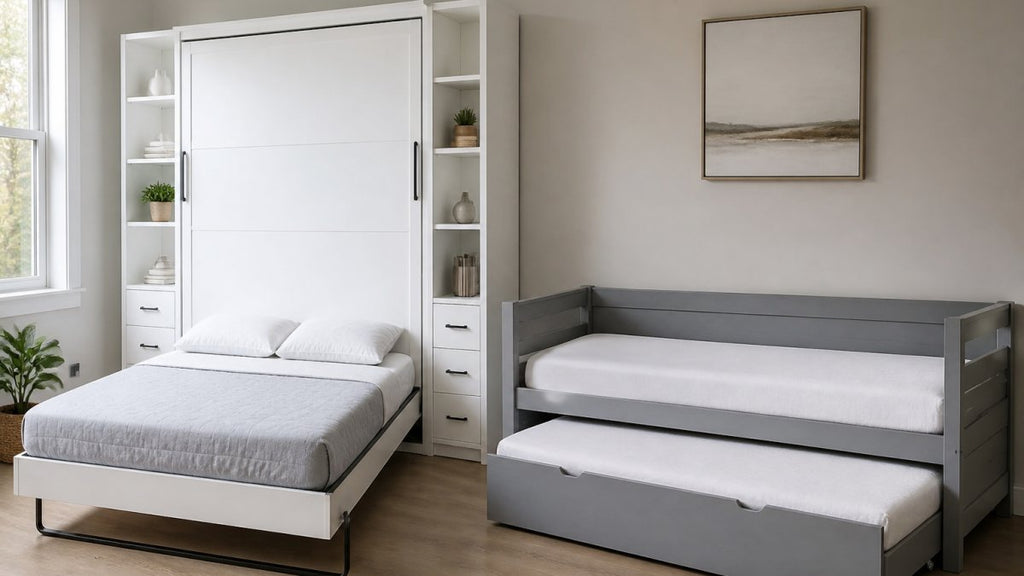
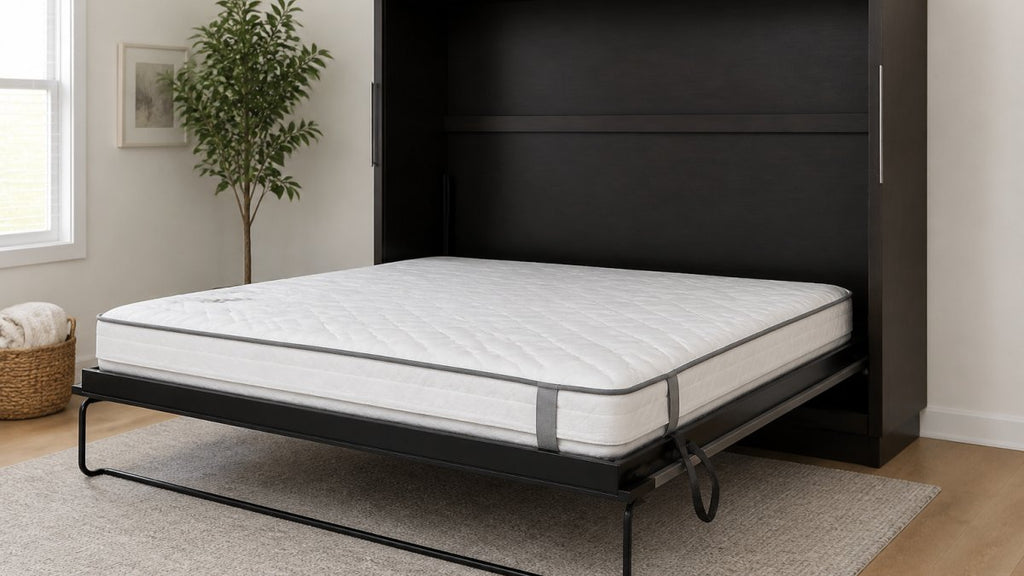
When comparing a wall bed vs trundle bed, a wall bed (also called a Murphy bed) folds up vertically into a wall-mounted cabinet, freeing floor space when not in use. The mechanism uses springs or pistons to support the mattress and frame, allowing smooth folding for rooms where square footage is at a premium.
Wall beds are built into custom cabinetry that matches your room's aesthetic. When closed, the cabinet resembles wall-mounted storage; open it and a full mattress platform extends into the room. Most accommodate queen-sized mattresses.
At Comfort Zone Shop, we specialize in wall beds engineered with solid hardwood construction and high-quality mattresses. Our Traditional Wallbeds feature a piston mechanisms that require minimal effort to operate.

Pro TipWall beds work best in multipurpose rooms where you need the space to function as both a bedroom and a home office, guest room, or living area during the day.
What Is a Trundle Bed?
A trundle bed is a low-profile frame that slides under another bed on casters (wheels), providing an additional sleeping surface for guests or children.
Trundle beds require no wall mounting or cabinetry, just simple assembly. They double sleeping capacity without extra floor space when the second bed isn't needed, though the mattress sits lower and requires adequate clearance underneath.
The main appeal is simplicity and affordability. However, mattress thickness is limited by clearance under the upper bed, which affects comfort for extended use.
Space-Saving Capabilities: Wall Beds and Trundle Beds Compared
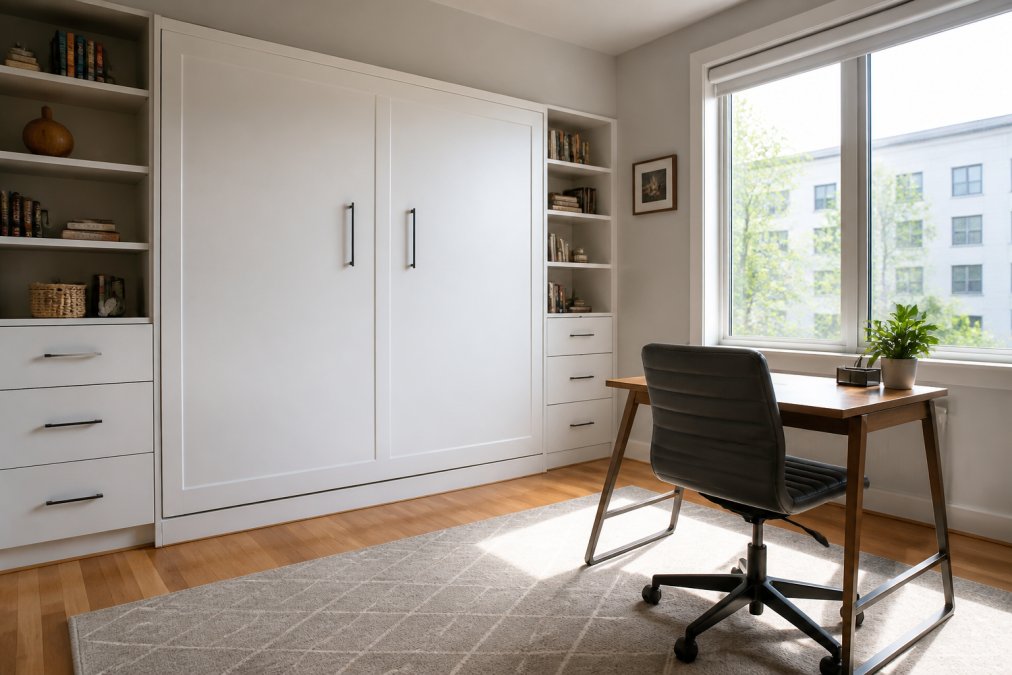
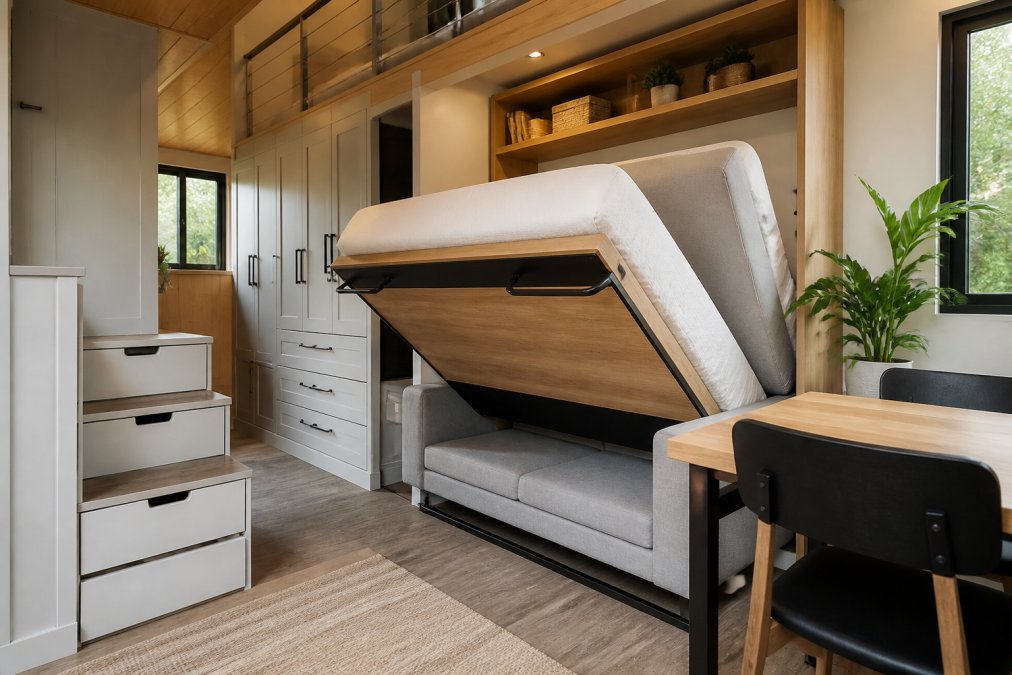
Wall beds maximize floor space in compact living situations. When closed, they occupy minimal footprint like wall art or cabinetry, leaving room open for a desk, seating area, or other furniture.
Trundle beds save space vertically by nesting under an existing frame, but don't free up the primary bed's footprint. The trundle slides out horizontally, requiring clearance on one or both sides.
In the debate of wall bed vs trundle bed, wall beds excel in multipurpose rooms while trundle beds work better for occasional overflow capacity in dedicated bedrooms.
Feature |
Wall Bed |
Trundle Bed |
|---|---|---|
Floor space when not in use |
Minimal (wall-mounted) |
Full primary bed footprint |
Suitable for multipurpose rooms |
Yes |
No |
Installation complexity |
Professional setup required |
Simple assembly |
Daily operation |
Quick fold/unfold |
Roll in and out |
Murphy Bed Cabinets for Guest Rooms: Comfort and Mattress Quality
Murphy bed cabinets for guest rooms must deliver genuine comfort. Mattress quality determines whether guests sleep well or experience back pain.
Comfort Zone Shop's wall beds come standard with premium gel memory foam mattresses featuring tri-fold construction with warranties up to 10 years. This supports proper spinal alignment and reduces pressure points for multi-night guest stays.
Trundle beds use thinner mattresses (5-6 inches) due to space constraints, while wall bed mattresses reach 8-10 inches.
Wall beds feature elevated platforms that ease entry and exit for older guests or those with mobility concerns. Trundle beds sit lower.
Key TakeawayFor guest rooms where comfort matters, wall beds with quality memory foam mattresses provide significant comfort. The extra mattress thickness and elevated platform contribute to comfortable extended stays.
Custom Mattress Sizing for Wall Beds: Getting the Right Fit
A key advantage of wall beds is custom mattress sizing to fit exact frame dimensions. If your cabinet is 54 inches wide instead of standard 60 inches, a custom mattress ensures a perfect fit.
Comfort Zone Shop manufactures custom-sized mattresses in-house, eliminating gaps, preventing rolling, and ensuring full support across the sleeping surface.
Custom sizing also applies to thickness, thinner mattresses for limited space or thicker ones for added comfort.
Custom Home Office and Cabinetry →
Trundle beds offer no such flexibility, you're limited to standard twin or full sizes that fit under the primary bed.
Trundle Bed Mattress Thickness Limits and Durability
Trundle mattresses face thickness limits due to clearance constraints. Most allow 5-7 inches, limiting options to thin foam or low-profile coils.
The compression problem: A thin mattress with springs (5-6 inches) compresses faster under regular use because the foam or coil system has less material to distribute weight. After 2-3 years of weekly guest visits, you may notice sagging in the center and reduced support at the edges. The durability issue may become worse if the trundle is used nightly rather than occasionally. Thin construction may not be engineered for daily wear. By comparison, wall bed mattresses (8-10 inches) use higher-density foam that resists compression and maintains support for 10+ years with proper care.
Safety and weight capacity: Trundle mattresses typically support 250-300 pounds maximum, while wall bed mattresses support 400+ pounds. This matters if you have heavier guests or if children will use the trundle regularly. A child jumping on a thin trundle mattress can cause premature sagging. Wall beds, with their elevated platform and thicker mattress, may provide safer sleeping surfaces for children and heavier users.
Flooring interaction: Trundle beds sit on caster wheels that roll across your floor. On hardwood, the wheels can create permanent grooves if the trundle is rolled in and out frequently. On carpet, the wheels can snag fibers and create worn paths. The mattress itself may absorb moisture from carpet, especially in humid climates. Wall beds don't have this issue because they're mounted to the wall and don't roll across flooring.
Maintenance and replacement costs: When a trundle mattress fails (typically within 3-5 years of regular use), replacement costs $350-$600 for a quality option. Over a 15-year period, you may replace a trundle mattress 3-4 times, totaling $450-$1,200 in mattress replacement alone. Wall bed mattresses, while more expensive upfront ($800-$1,500), may not need replacement within 15 years, making them a potentially cost-effective long-term option.
Watch OutThin trundle mattresses may deteriorate quickly under regular use. If you plan to use the second bed more than once a week, you may need to replace the mattress within 3-5 years. Wall bed mattresses may hold up longer and provide good support for heavier users and children.
Ease of Use, Installation, and Long-Term Maintenance
Wall beds require professional installation because they involve mounting heavy cabinetry to wall studs and setting up the spring or piston mechanism. Comfort Zone Shop handles the installation process, which ensures the bed operates smoothly and safely. The Clover and Daisy models come with the base packed inside the fully assembled cabinet, reducing on-site assembly time.

Once installed, daily operation is simple for most users. Modern wall beds use piston-assisted mechanisms that require minimal physical effort to open and close, typically 10-15 pounds of force. This matters significantly for elderly users, people with arthritis, or anyone with limited upper-body strength. A guest with mobility concerns may be able to operate the bed without strain, making it accessible for extended stays.
Trundle beds are simpler to set up. You assemble the frame, slide it under the primary bed, and you're done. No wall mounting, no professional installation. However, the accessibility trade-off is real: pulling a trundle bed out from under a primary frame requires bending, reaching, and horizontal dragging motion. For users with back problems, knee issues, or balance concerns, this repeated motion may create physical strain. Elderly guests may struggle with trundle beds, especially if the primary bed sits high and the trundle sits low, the height differential may make entry and exit difficult.
Long-term mechanical durability differs significantly between the two. Wall beds use either coil springs or hydraulic pistons. Coil springs may require occasional lubrication (annually) to prevent squeaking and maintain smooth operation.
Key TakeawayWall beds may excel for accessibility, the spring-assisted mechanism requires minimal physical effort, making them ideal for elderly guests or users with mobility concerns. Trundle beds may demand more physical strain to operate and become harder to use as users age. If your household includes people over 65 or with chronic pain, a wall bed's ease of operation may provide benefits over a decade of use.
Which Bed Type Should You Choose?
Choose a wall bed if you're converting a room into a multipurpose space, need to maximize floor area, or want genuine guest comfort. Wall beds work best in small apartments, condos, or homes where every square foot matters. They're ideal for home offices that double as guest rooms, or spare bedrooms that need to function as living space during the week.
Frequently Asked Questions
What are the main disadvantages of a trundle bed?
Trundle beds have limited mattress thickness options, typically 5-8 inches, which affects comfort for regular use. The lower bed sits close to the floor, making it difficult for people with mobility issues to access. Trundle mattresses also wear faster due to frequent rolling in and out. They occupy floor space even when not in use, and the mechanism can become stiff or noisy over time with daily operation.
What are the main downsides of using a wall bed or Murphy bed?
Wall beds require significant wall space and may not fit all room layouts or apartment configurations. Installation demands professional help in most cases, adding to the initial cost. Some models have weight capacity limits. Poor-quality wall beds can develop mechanical issues or become difficult to operate. However, Comfort Zone Shop's custom-built Murphy bed cabinets come with a 10-year warranty and solid hardwood construction, addressing durability concerns that plague cheaper options.
How does floor space usage differ between wall beds and trundle beds?
Wall beds free up nearly all floor space when closed, with some models occupying as little as 10 square feet when stored. Trundle beds consume floor space continuously because the lower bed sits underneath the frame. Even when the trundle isn't pulled out, the structure takes up room. For small apartments or rooms that need to serve multiple purposes—like a home office and guest bedroom—wall beds provide significantly more usable floor space for furniture, storage, or daily activities.
Can I get a custom mattress for a wall bed, and what sizes are available?
Yes. Comfort Zone Shop manufactures custom-sized mattresses specifically for wall beds, ensuring a perfect fit for your unique room dimensions. Custom mattress sizing eliminates gaps and ensures proper support. The Daisy and Clover Murphy Cabinet Beds come with tri-fold premium gel memory foam queen mattresses, with warranty options ranging from 3 to 10 years. This customization is one of the key advantages of working with a specialty sleep shop rather than ordering a standard-sized bed online.
Related post
01
Oct
30
Sep
27
Sep