
Custom Mattress for Wall Beds: The Complete Guide
Table of Contents
- Why a Standard Mattress Often Fails in a Wall Bed
- Murphy Bed Mattress Thickness Requirements Explained
- Memory Foam vs Innerspring for Wall Beds: Which Holds Up?
- How to Measure for a Wall Bed Mattress
- Custom Mattress Sizing: DIY vs. Professional Manufacturing
- Standard vs. Custom Mattress Sizes for Wall Beds
- Installation, Safety Straps, and Getting the Fit Right
- Conclusion
Last Updated: August 12, 2026
Why a Standard Mattress Often Fails in a Wall Bed
A custom mattress for wall beds is not a luxury upgrade, it's a functional necessity. Standard mattresses are engineered for horizontal use on a platform or box spring. A wall bed stores the mattress vertically for hours or days at a time, creating entirely different demands.
The most common failure point is thickness. Standard queen or full mattresses measure 10 to 14 inches thick, but most wall bed cabinets have a maximum depth of 12 inches for the mattress compartment. Anything thicker will prevent the door from closing flush, stress the folding mechanism, and warp the cabinet frame.
Standard mattresses also weren't designed for repeated vertical loading. Foam layers compress unevenly, and innerspring coils can shift when stored upright. Many homeowners notice sagging and loss of support within the first year, problems a properly specified mattress avoids entirely.
This is where Comfortzone1 sees the most frustration: customers buy a wall bed, order a standard mattress online, and find the bed won't close or the mattress breaks down quickly. Getting the mattress right from the start saves money and aggravation.
Wall bed performance is inseparable from mattress specification. Every decision about thickness, weight, and materials feeds back into how well the mechanism works, how long the mattress lasts, and how comfortable the sleeping surface remains.
Murphy Bed Mattress Thickness Requirements Explained
Murphy bed mattress thickness requirements are the single most critical specification. The ideal thickness is between 6 and 10 inches, with most cabinet manufacturers specifying a hard maximum of 10 to 12 inches depending on frame design.
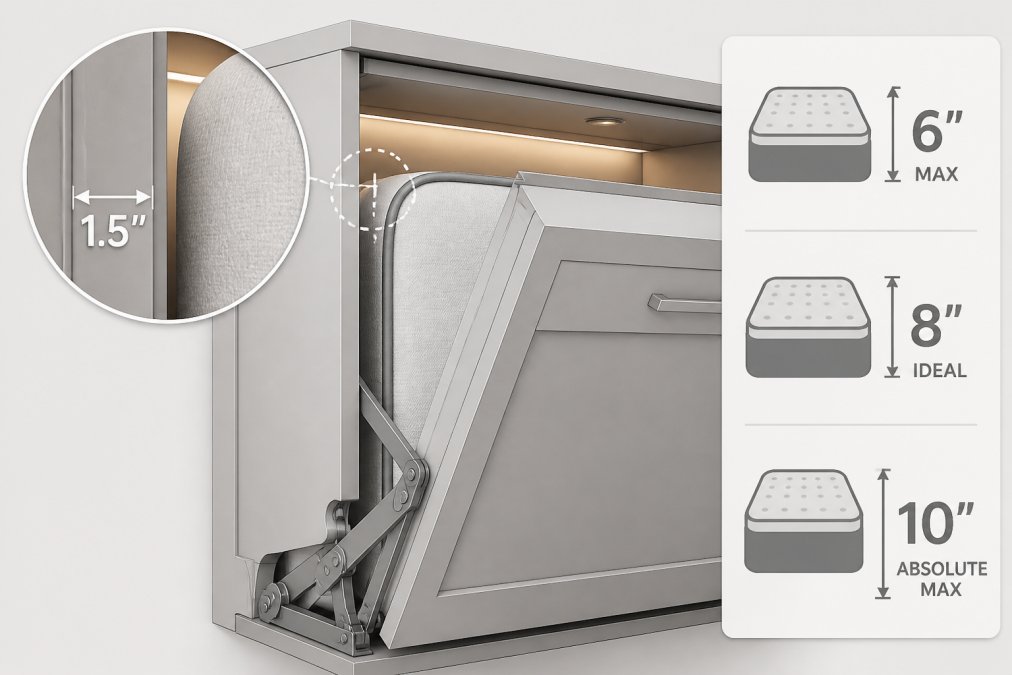
This isn't arbitrary. The cabinet depth is engineered around the mattress profile. When the mattress exceeds that profile, the door can't close, and forcing it damages the hinges, spring mechanism, and cabinet face.
Cabinet Clearance and the Folding Mechanism
Cabinet clearance is the measurement between the interior back wall and the closed door panel. The mattress must fit within this space with a quarter to half inch on each side to allow for natural compression and expansion from temperature and humidity changes.
The folding mechanism's counterbalance system is calibrated to a specific weight range. Exceeding that range puts constant strain on the spring tension system, making the bed difficult to operate and risking sudden drops rather than controlled lowering.
A properly fitted mattress lets the counterbalance do its job. The bed should lower with light pressure and rise with minimal effort.
Weight Capacity and Spring Tension Calibration
Every wall bed mechanism is rated for a specific total weight: the mattress plus the sleeper. The spring tension is factory-set to match the rated mattress weight, typically between 50 and 80 pounds for a full or queen.
A mattress significantly lighter than rated will cause the mechanism to over-retract, slamming the bed back aggressively. A heavier mattress makes the bed difficult to lift and may cause premature failure. Always confirm the mechanism's weight rating before selecting a mattress, and choose one that falls within that range.
Memory Foam vs Innerspring for Wall Beds: Which Holds Up?
The choice between memory foam and innerspring is not simply about sleeping preference, it's about durability under non-standard conditions.
Memory foam performs better in vertical storage. The material has no internal components that shift when stored upright, and high-density foam retains shape well over repeated fold-and-unfold cycles. The tradeoff is weight: memory foam is often heavier per inch of thickness, which matters for spring tension calibration.
Innerspring mattresses are lighter for a given thickness, but the coil structure is vulnerable to vertical loading. Coils were designed to compress under vertical pressure from above, not to hold shape while standing on end. Many innerspring wall bed mattresses show noticeable coil shift within two to three years of regular use.
According to Sleep Foundation's mattress durability research, foam-based constructions generally outlast innerspring in non-standard orientations, which aligns with what wall bed users consistently report.
Hybrid Options and Long-Term Durability in Vertical Storage
Hybrid mattresses offer a middle ground but require careful evaluation. The key variable is coil gauge and pocket construction. Individually pocketed coils resist shift better than open coil systems. A well-constructed hybrid with a firm foam base can perform well in a wall bed for many years.
Long-term durability depends on whether the mattress maintains its support profile after 500 or 1,000 vertical storage cycles. Foam-only and high-quality hybrid options generally do. Budget innerspring options generally do not.
Breathability and Heat Retention Inside an Enclosed Cabinet
Enclosed cabinet storage creates a specific problem: heat and moisture buildup. When a wall bed is closed, the mattress sits in a sealed or semi-sealed space with limited airflow. Memory foam retains heat and releases moisture slowly, which can accelerate material breakdown and encourage mold growth in humid climates.
The fix is to choose foam formulations with open-cell structure or gel infusion for better air circulation. Latex foam is naturally breathable, resistant to moisture retention, and holds shape well in vertical storage. As the EPA's guidance on indoor air quality and moisture control makes clear, managing moisture inside enclosed furniture is a genuine health consideration. Breathability should be a specification requirement.
How to Measure for a Wall Bed Mattress
Measuring for a wall bed mattress correctly takes about 15 minutes and prevents the most common ordering mistakes.
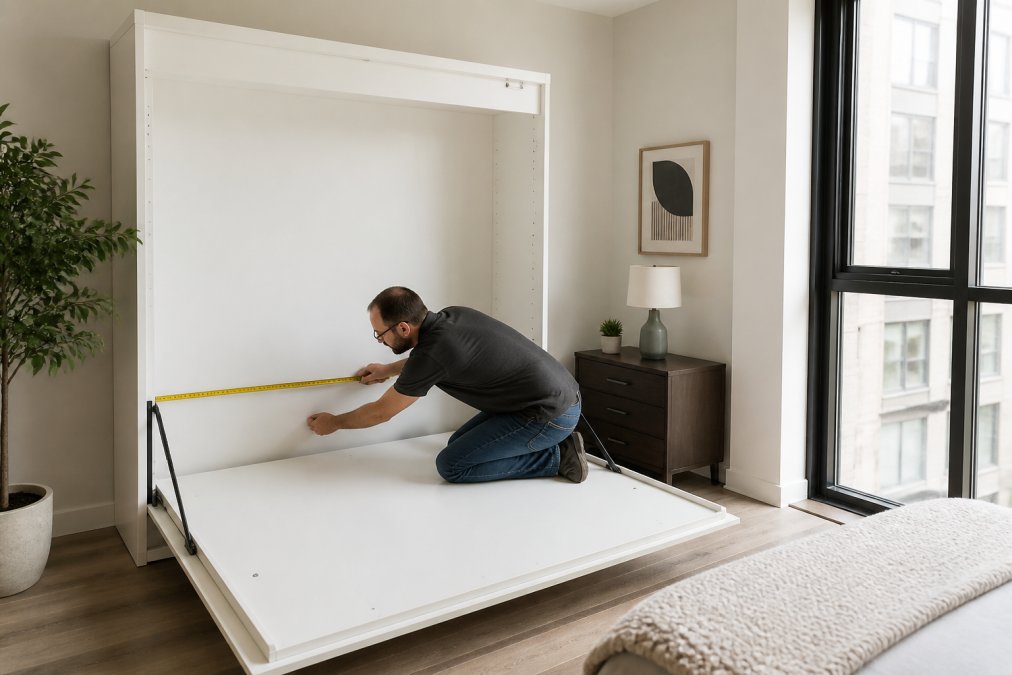
Here is the complete measurement checklist:
- Measure the interior width of the cabinet opening at three points: top, middle, and bottom. Use the smallest measurement.
- Measure the interior length of the sleeping platform from head to foot at three points. Use the smallest measurement.
- Measure the cabinet depth from the back wall to the interior face of the door panel when closed. This is your maximum mattress thickness.
- Note the mechanism's rated weight capacity from the manufacturer's documentation.
- Record the floor-to-ceiling clearance if the cabinet is freestanding and height-adjustable.
The most common mistake is measuring the frame opening rather than the sleeping platform itself. The platform is often slightly smaller due to retaining lips or safety strap hardware. Always measure the platform surface directly.
A secondary mistake is ignoring the depth measurement and assuming a standard thickness will work. Measure the depth first, then shop for a mattress that fits within it.
Custom Mattress Sizing: DIY vs. Professional Manufacturing
Custom mattress sizing is either a weekend project or a professional order, depending on how non-standard your wall bed dimensions are.
DIY approaches involve purchasing foam in bulk and cutting it to size, then wrapping it in fabric. This works adequately for simple foam-only mattresses with slightly off-standard dimensions. The limitations are real: cutting foam cleanly requires an electric knife and straight edge, achieving consistent density is difficult, and the resulting mattress lacks the edge support and cover finish of a manufactured unit.
Professional custom mattress manufacturing produces a mattress built to exact specifications from the ground up. Foam layers are cut to size before assembly, the cover is sewn to fit, and the finished product performs like a purpose-built component. For wall beds with non-standard dimensions, this is the correct approach.
As the Consumer Product Safety Commission's guidance on furniture safety standards notes, mattresses used in enclosed furniture systems should meet applicable flammability and safety standards. A professional manufacturer ensures compliance; a DIY foam cut may not.
Comfortzone1 manufactures custom-sized mattresses to order, built to your exact wall bed frame dimensions, eliminating guesswork and ensuring correct mechanism performance.
Standard vs. Custom Mattress Sizes for Wall Beds
Most wall beds are built around standard mattress dimensions, but "standard" in the wall bed world differs from standard bedding dimensions.
| Wall Bed Size | Wall Bed Mattress Dimensions | Standard Mattress Dimensions | Typical Thickness Max |
|---|---|---|---|
| Twin | 38" x 74" | 38" x 75" | 10" |
| Full | 54" x 74" | 54" x 75" | 10-12" |
| Queen | 60" x 74" | 60" x 80" | 10-12" |
| Queen (long) | 60" x 80" | 60" x 80" | 10" |
| Custom | Varies | N/A | Per cabinet spec |
The length difference is most important. Standard mattresses are typically 75 to 80 inches long. Wall bed sleeping platforms are often 74 inches to accommodate the cabinet frame. A standard queen mattress will overhang by up to six inches, preventing the bed from closing.
Custom sizing addresses both the length issue and any width variations from non-standard cabinet builds. Hand-crafted wall beds often have dimensions outside the standard range entirely.
Installation, Safety Straps, and Getting the Fit Right
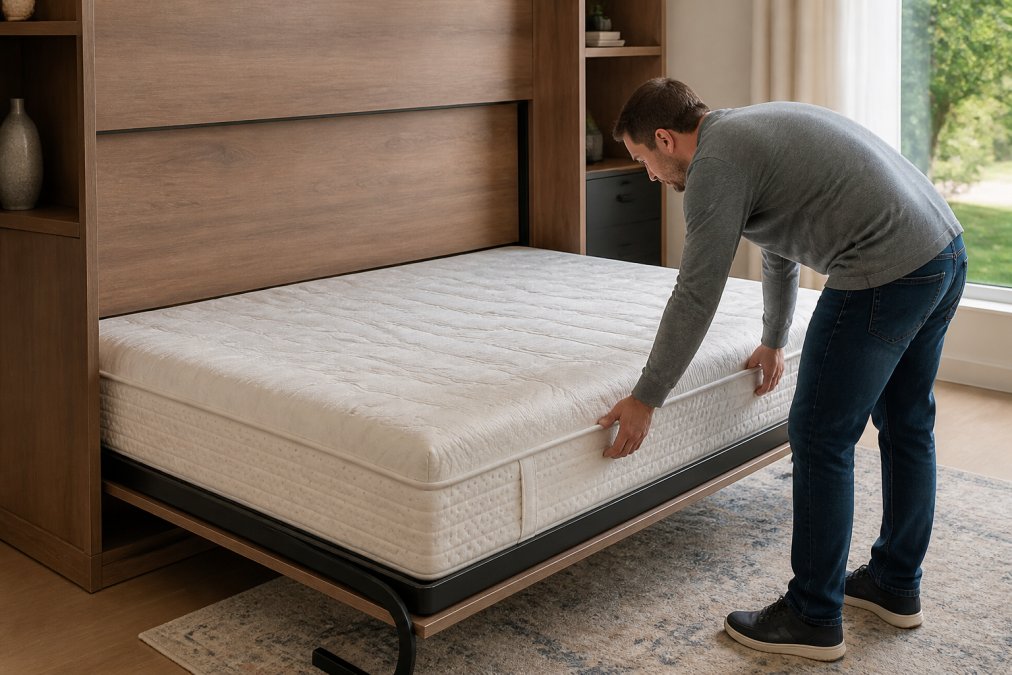
A correctly installed wall bed mattress is secured to the sleeping platform with safety straps, typically two to four nylon or webbing straps that wrap around the mattress and attach to platform anchor points. These straps prevent the mattress from sliding when the bed is raised and lowered, which is both a safety requirement and mechanism protection.
Getting the fit right means the mattress sits flush with the platform surface, the straps hold it without compressing the edges, and the cabinet door closes without resistance. If any of these conditions aren't met, the mattress specification needs revision before regular use.
Safety straps should be snug but not tight enough to indent the mattress surface. If the cabinet door requires more than light pressure to close, the mattress is either too thick or too long, do not force it. Upholstery should be smooth and low-friction against the cabinet interior. For lightweight mattresses in mechanisms with fixed spring tension, a small amount of counterbalance weight can be added to the platform to bring the total within the mechanism's rated range.
A wall bed that operates smoothly and sleeps comfortably is the product of correct specification. For guidance on structural requirements of wall-mounted furniture, the American National Standards Institute furniture safety standards provides applicable benchmarks for residential installations.
Finding the right custom mattress for a wall bed is more technical than most buyers expect. The consequences of getting it wrong, a mechanism that strains, a mattress that degrades prematurely, a cabinet that won't close, are frustrating and expensive to fix after the fact. Comfortzone1 specializes in exactly this problem: custom-sized mattress manufacturing built to your wall bed frame specifications, with fast local delivery and professional guidance through every step of the selection process. Reach out to the Comfortzone1 team to get your measurements confirmed and find the custom mattress that fits your wall bed correctly from day one.
Frequently Asked Questions
Do you need a special mattress for a wall bed?
Yes. A standard off-the-shelf mattress is often too thick or too heavy for a wall bed's folding mechanism. Wall beds require a mattress with a specific profile, typically between 8 and 12 inches, so the cabinet closes fully and the counterbalance spring tension works correctly. A mattress that is too thick prevents the cabinet door from latching, while one that is too heavy strains the hardware over time. A custom mattress built to your frame's exact specifications solves both problems.
How thick of a mattress do I need for a Murphy bed?
Most Murphy bed mechanisms are designed for mattresses between 8 and 12 inches thick. The exact limit depends on your cabinet's interior depth and the hardware manufacturer's specifications. Exceeding the recommended thickness prevents the cabinet from closing and puts stress on the spring or piston mechanism. Always check your frame's documentation for the maximum mattress profile before ordering. If your wall bed has non-standard cabinet depth, a custom mattress manufactured to those dimensions is the safest option.
Can a memory foam mattress be used in a wall bed?
Memory foam works well in a wall bed as long as the profile stays within the cabinet's clearance limit, typically under 12 inches. Foam mattresses are lightweight, which reduces strain on the counterbalance mechanism. The main concern is heat retention: foam stored vertically inside an enclosed cabinet gets less airflow than a mattress on an open bed frame. Choosing an open-cell or gel-infused foam addresses that. A custom mattress for wall beds can be built with breathable foam layers specifically suited to vertical storage.
What are the weight limitations for wall bed mattresses?
Weight limits vary by hardware manufacturer and cabinet construction, but most residential wall bed mechanisms are rated to support a combined mattress and occupant weight specified in the frame's documentation. The mattress itself should generally stay under 80 to 100 pounds so the spring tension or piston counterbalance can lift and lower it safely without excessive force. Heavier innerspring or pillow-top mattresses can exceed this threshold. A lightweight memory foam or hybrid custom mattress built to the right profile is often the safest choice for long-term mechanism health.
This article was written using GrandRanker