
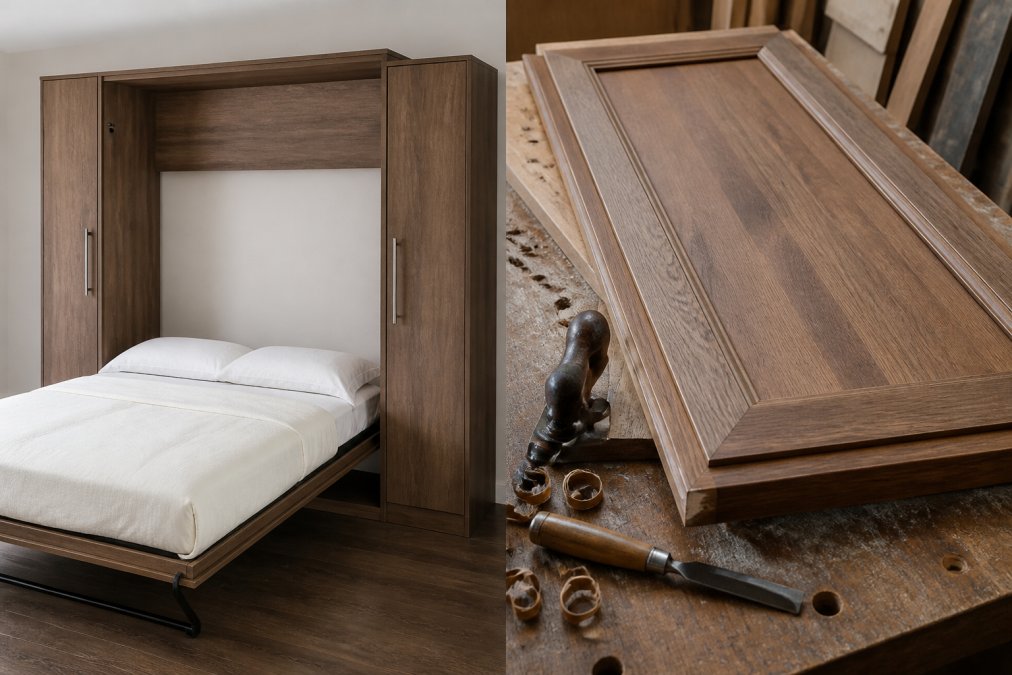
Murphy Bed vs Accent Woodworking: Which Is Better?
Table of Contents
- Murphy Bed vs Accent Woodworking: A Side-by-Side Comparison
- Key Differences Between a Murphy Bed and Accent Woodworking
- The Benefits of Cabinet Beds for Multi-Use Rooms
- Murphy Bed Mattress Compatibility and Comfort
- Custom Wall Bed Installation: What to Expect
- Durability, Maintenance, and Safety Considerations
- Which One Should You Choose? A Decision Framework
- Frequently Asked Questions
Last Updated: September 9, 2026
Murphy Bed vs Accent Woodworking: A Side-by-Side Comparison
When homeowners search for a murphy bed vs accent woodworking, they are comparing two paths to the same goal: reclaiming floor space without sacrificing a real bed. Accent woodworking refers to custom cabinetry shops that build wall beds as part of a larger portfolio, while a dedicated Murphy bed specialist focuses exclusively on the engineered mechanism, mattress compatibility, and daily fold-down reliability. The mechanism, not the wood frame, determines whether your bed still opens smoothly after five years of use.
At Comfort Zone Shop, we build and install cabinet beds daily in the Tampa Bay area, giving us a clear view of where each approach wins. This guide breaks down the structural, practical, and cost differences, covering installation expectations, mattress compatibility, durability, and a decision framework for your room.
Key Differences Between a Murphy Bed and Accent Woodworking
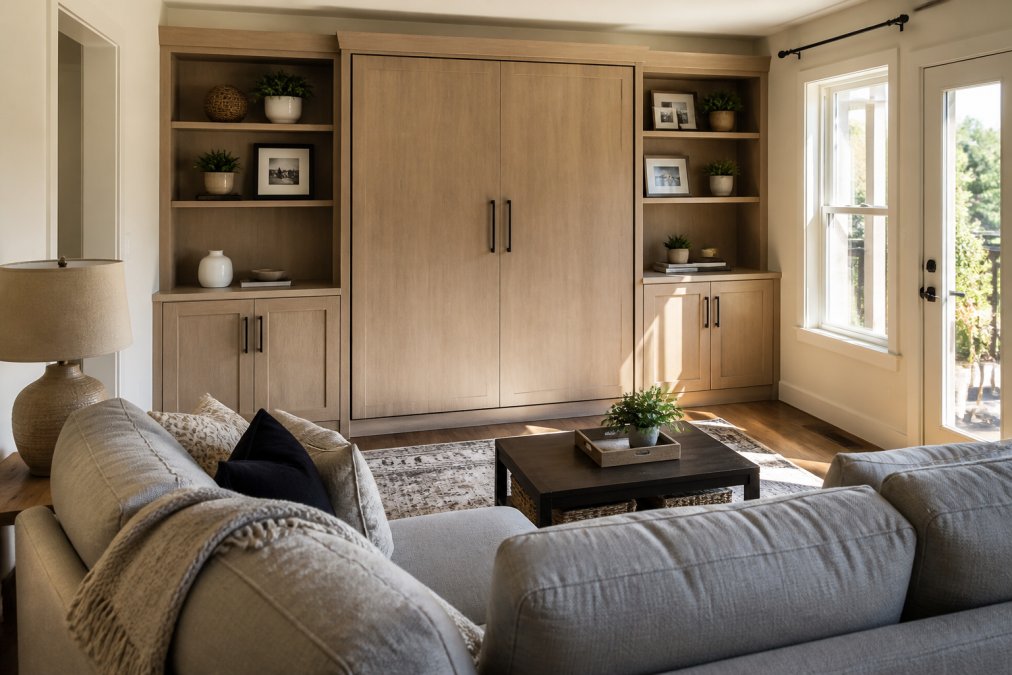
A Murphy bed is a space-saving system built around an engineered folding mechanism and counterbalanced frame that tucks vertically into a cabinet. Accent woodworking, by contrast, is a custom cabinetry service that may produce a wall bed among many projects, such as built-in shelving or kitchen cabinetry. The core difference is specialization: a Murphy bed specialist engineers the product around the fold-down hardware, while a general woodworker treats the bed as one component of a larger project.
This distinction drives real outcomes. A dedicated wall bed uses plywood sidewalls and a steel mechanism rated for daily use, with the platform engineered to specific clearance tolerances. A general cabinet shop may build a beautiful face frame but source an off-the-shelf mechanism without the same integration. Ask any provider about the mechanism brand, weight capacity, and hardware warranty. The frame is only half the product; the mechanism does the work.
| Comparison Point | Dedicated Murphy Bed Specialist | Accent Woodworking / General Cabinet Shop |
|---|---|---|
| Core focus | Engineered fold-down bed systems | Custom cabinetry and millwork |
| Mechanism integration | Designed around specific hardware | Often sourced separately |
| Typical lead time | Shorter, product built to spec | Longer, project-based scheduling |
| Warranty | Often 10 years on the bed system | Varies by project contract |
| Best for | Multi-use rooms needing reliable daily function | Full-room custom built-ins with a bed included |
The Benefits of Cabinet Beds for Multi-Use Rooms
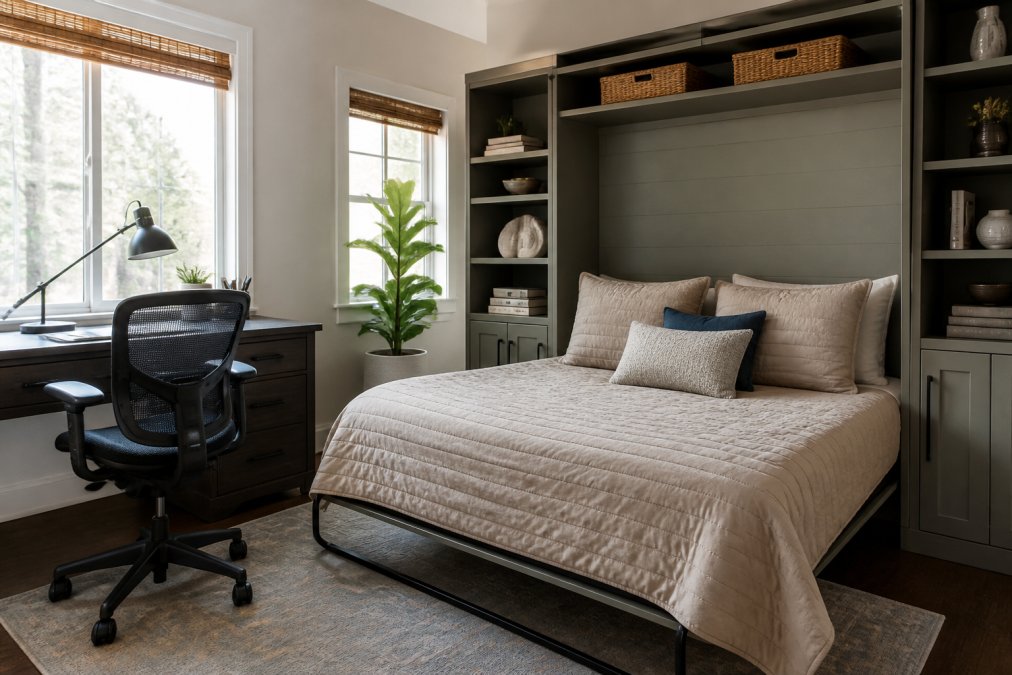
Cabinet beds excel in multi-use rooms because they return the floor to its primary purpose within seconds. A home office, craft room, or gym can host guests without permanently sacrificing square footage to a bed that sits unused most of the year. When closed, a quality cabinet bed occupies roughly 10 square feet of floor space, the key benefit for apartments and condos where every foot counts.

The design advantages go beyond the folded footprint. A well-built cabinet bed includes integrated storage, such as a large rolling drawer for bedding and pillows. Many models also feature a built-in dual power and USB module, letting you charge devices without running cords across the room. These details transform the experience from a pull-out couch compromise to a genuine bedroom.
Pro Tip
When planning a multi-use room, measure the closed cabinet depth, not just the open bed length. A shallow sleep enclosure design keeps the cabinet profile closer to the wall, preserving valuable walking space even when the bed is stored.
Murphy Bed Mattress Compatibility and Comfort
Murphy bed mattress compatibility is one of the most overlooked factors in the buying decision. A wall bed requires a mattress that folds cleanly without damaging the internal structure. Standard innerspring mattresses are too rigid to fold repeatedly, which is why tri-fold gel memory foam mattresses are the industry standard.
The mattress must also match the platform's clearance dimensions exactly. A mattress that is too thick will not close properly; one that is too thin leaves an uncomfortable gap. A provider that manufactures custom-sized mattresses offers a significant advantage, ensuring proper clearance and consistent comfort.
Key Takeaway
The mattress is part of the engineered system, not an accessory. Confirm your provider offers a tri-fold gel memory foam option matched to the platform, and verify the warranty covers both the bed mechanism and the mattress.
Custom Wall Bed Installation: What to Expect
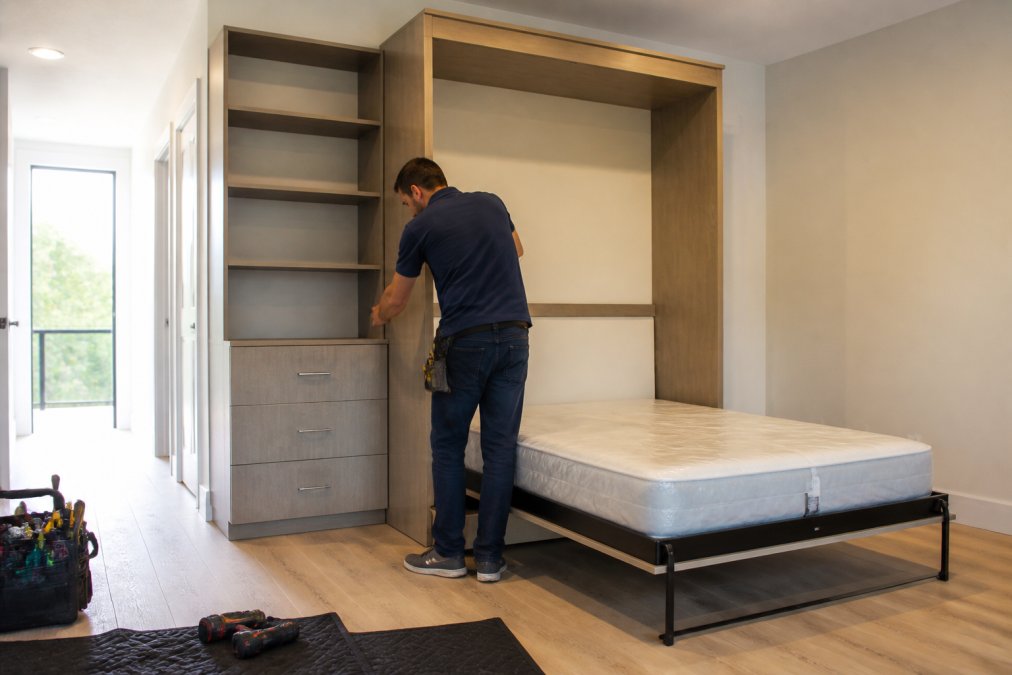
Custom wall bed installation begins with a site assessment to confirm the wall can support the load and that the room has adequate clearance for the fold-down motion. A queen-sized wall bed is heavy, and the mounting points must anchor into structural studs, not just drywall. Professional installation is strongly recommended, as an improperly mounted bed poses a safety risk.
The installation process is straightforward when handled by an experienced team. The cabinet arrives fully assembled, shortening on-site work considerably. The installer positions the unit, secures it to the wall studs, and verifies the mechanism operates smoothly through several cycles. The entire process typically completes in a single visit, and the bed is ready for use the same day.
Watch Out
Never mount a wall bed to drywall anchors alone. The combined weight of the cabinet, mechanism, and mattress requires a load-bearing connection to wall studs. An improper mount can cause the bed to pull away from the wall over time, creating a serious safety hazard.
Durability, Maintenance, and Safety Considerations
A wall bed is a mechanical product, and its longevity depends on the quality of its moving parts as much as its wood construction. Solid hardwood resists warping and provides a stable base, but the steel folding mechanism and hinges endure the most stress. Look for a limited warranty that covers the mechanism for a decade, signaling confidence in the hardware's durability.
Mechanism Longevity: A Maintenance Guide
The primary failure point in a wall bed is not the wood frame but the mechanical components, specifically the piston, spring, and hinge assembly. While initial build quality is crucial, the long-term value of your investment hinges on a simple, annual maintenance routine many owners overlook.
The Annual Check-Up:
- Inspect the Pivot Points and Hinges: Look for signs of wear, such as metal shavings or unusual play in the joints. The pivot points should feel tight and move without resistance.
- Lubricate Moving Parts: Apply a dry-film lubricant (like a silicone spray) to the hinge pins and the mechanism's sliding track. Avoid oil-based lubricants, which attract dust and can gum up the mechanism over time.
- Verify the Locking Mechanism: The safety latch that prevents the bed from closing unexpectedly should engage with a firm, audible click. If it feels loose or fails to catch, stop using the bed and contact the manufacturer immediately.
- Check the Mattress Fold: Ensure the tri-fold mattress is folding evenly along its creases. An uneven fold can put lateral stress on the platform and cause the mechanism to bind.
Safety Certifications and Weight Limits: What to Ask For
A common gap in the market is the lack of standardized safety data. When comparing options, ask for specific, verifiable numbers that demonstrate the bed's safety margin.
- Rated Weight Capacity: Ask for the manufacturer's rated weight capacity for the mechanism. This number should comfortably exceed the combined weight of the mattress and the heaviest expected sleepers. A quality mechanism for a queen bed is typically rated to support well over 600 lbs, providing a significant safety buffer.
- Locking System Design: Inquire about the specific type of locking mechanism used. Look for a system that is mechanical and fails-safe, meaning it locks automatically when the bed is closed and requires a deliberate, two-step action to release. This is a critical feature for households with young children or pets.
- Material Certifications: While not a safety rating for the mechanism, confirm that the wood products used in the cabinet meet CARB (California Air Resources Board) Phase 2 standards for formaldehyde emissions. This is a widely recognized benchmark for indoor air quality in the United States.
Watch Out
Never mount a wall bed to drywall anchors alone. The combined weight of the cabinet, mechanism, and mattress requires a load-bearing connection to wall studs. An improper mount can cause the bed to pull away from the wall over time, creating a serious safety hazard.
By asking for these data points, you move beyond the vague promise of "durability" and verify the product is engineered to a standard that will protect your household for years. A provider that cannot answer these questions clearly may not be offering a mechanism built for daily use.
Which One Should You Choose? A Decision Framework
Choosing between a dedicated Murphy bed specialist and accent woodworking is rarely about which is "better" in the abstract. It is a practical decision driven by your room's dimensions, usage frequency, and the value you place on a single, integrated warranty.
The Cost-Benefit Analysis: Custom vs. Modular
The most significant difference between the two paths is often the price-to-value ratio. A dedicated specialist typically offers a productized system where the mechanism, cabinet, and custom mattress are designed as one unit, often with an all-inclusive price and a single warranty covering the entire system.
In contrast, accent woodworking projects are often billed by the hour or by the linear foot of cabinetry. When you commission a wall bed from a general cabinet shop, you are often paying for:
- Design time for the custom integration.
- The mechanism as a separate, itemized component (often a premium, name-brand unit).
- The cabinet build at a custom millwork rate.
- A separate mattress sourced from a third party.
This a la carte approach can lead to a higher final invoice, especially when coordinating multiple vendors. For a single, multi-use room, the dedicated specialist often provides a more predictable cost structure and a faster path to a finished bed.
Room Layout Planning: Visualizing the 'Space-Saving' Claim
The "space-saving" benefit is often quoted as a square footage number, but the real-world impact depends entirely on your room's layout. Before you commit, sketch out a simple floor plan to see how the bed will function in your space.
Key measurements to take:
- Closed Cabinet Depth: This is the most critical dimension. A standard wall bed cabinet is typically 16-18 inches deep. Measure this against your room's existing walking paths. A shallower cabinet can be the difference between a cramped hallway and a comfortable flow.
- Open Bed Clearance: The bed folds down into the room, so you need to ensure there is enough clear floor space for its full length. For a queen bed, this is roughly 80 inches. Ensure the bed does not block a door, closet, or window when open.
- Wall Stud Location: The bed must be anchored to structural studs. Before falling in love with a specific design, locate the studs in your chosen wall to ensure they align with the cabinet's mounting points. If they don't, you may need to add a mounting backer panel, which adds to the project scope.
A Practical Decision Matrix
To synthesize all this information, use this simple matrix to guide your choice:
| Consideration | Choose a Dedicated Specialist | Choose Accent Woodworking |
|---|---|---|
| Usage Frequency | Daily or weekly use for guests or as a primary bed. | Occasional use (a few times a year) where the bed is a secondary feature. |
| Project Scope | A single room conversion or a standalone piece of furniture. | A full-room renovation with custom built-ins, shelving, and a bed that must match perfectly. |
| Budget & Timeline | You want a predictable, all-inclusive price and a faster installation timeline. | You have a flexible budget and timeline for a bespoke piece that is part of a larger project. |
| Warranty & Support | You want a single point of contact and a comprehensive warranty covering the mechanism, cabinet, and mattress. | You are comfortable managing separate warranties for the cabinetry and the bed mechanism. |
For most homeowners converting a spare room into a dual-purpose office and guest space, the dedicated specialist wins on reliability, speed, and value. However, if you are already commissioning a full suite of custom cabinetry, integrating the bed into that project ensures a seamless design.
For buyers in the Tampa Bay area, Comfort Zone Shop combines the best of both approaches. Our cabinet beds are locally handcrafted with solid hardwood construction and a 10-year limited warranty, and we pair them with custom-sized tri-fold gel memory foam mattresses for a guaranteed fit. The Clover Murphy Cabinet Bed exemplifies this approach at $2,195.00, featuring a large rolling storage drawer, higher sleep platform, built-in dual power and USB module, and a base packed inside the fully assembled cabinet for quick setup.
Frequently Asked Questions
What are the main differences between a Murphy bed and custom accent woodworking?
A Murphy bed is a space-saving furniture piece with a fold-down mechanism designed to hide a mattress inside a cabinet. Accent woodworking refers to custom cabinetry built to match your existing decor, which can include a wall bed but focuses on aesthetic integration and built-in features. The main differences come down to purpose, materials, and customization. Murphy beds prioritize function and mechanism quality, while accent woodworking emphasizes seamless design and custom finishes. A quality option combines both, offering a solid hardwood mechanism with a custom cabinet finish.
Are Murphy beds durable enough for daily use?
Yes, when built with solid hardwood construction and high-quality pistons or springs, a Murphy bed handles daily use without issue. Look for beds with a 10-year warranty on the mechanism and cabinet, which signals the manufacturer's confidence in durability. The Clover Murphy Cabinet Bed from Comfort Zone Shop features solid hardwood construction and a limited 10-year warranty, making it suitable for everyday folding and unfolding. Regular maintenance, like checking hardware and lubricating moving parts, extends the life of the mechanism well beyond a decade.
What materials should I look for in a high-quality Murphy bed?
Prioritize solid hardwood construction over particle board or MDF. Solid wood, like maple or oak, provides better structural integrity for the fold-down mechanism and resists wear over time. Check the plywood sidewall thickness and the quality of the pistons, which control the bed's descent. A high-quality Murphy bed includes a premium gel memory foam mattress that folds cleanly without damage. The Clover and Sagebrush models use solid hardwood and include tri-fold premium gel memory foam mattresses, offering both durability and comfort.
Can a cabinet bed mattress be replaced with a standard mattress?
Murphy bed mattress compatibility is specific. Standard mattresses are not designed to fold and will crease or damage the internal structure over time. Cabinet beds require a tri-fold gel memory foam mattress that bends at designated points, allowing the bed to close flat into the cabinet. When replacing the mattress, order a tri-fold model made for Murphy beds. Comfort Zone Shop offers custom-sized tri-fold mattresses with warranties ranging from 3 to 10 years, ensuring a proper fit for your specific cabinet dimensions.